Most organisations are not short of AI ideas.
They are short of visibility beyond what they already know.
Internal teams naturally start from the processes, problems and technologies already inside their field of view. That is valuable. It is also exactly how blind spots are created.
Building internally is necessary — and not enough
The internal foundations matter. Idea funnels, prioritisation boards, data programmes, governance — organisations that invest in them are doing the right thing, and none of this article argues otherwise.
But there is a structural limit, and it has nothing to do with talent.
No business or technology team can run its daily operation and continuously track the full evolution of AI: new model capabilities, agentic patterns, platform shifts, vendor moves, what adjacent industries are quietly automating, and which economics changed this quarter. Expecting that of internal teams is not ambitious — it is unrealistic.
So internal pipelines fill up with ideas drawn from what people can already articulate: known problems, known inefficiencies, known technologies. Useful. And systematically incomplete.
The four stages of AI capability awareness
A simple way to see the problem is to map awareness against capability maturity.
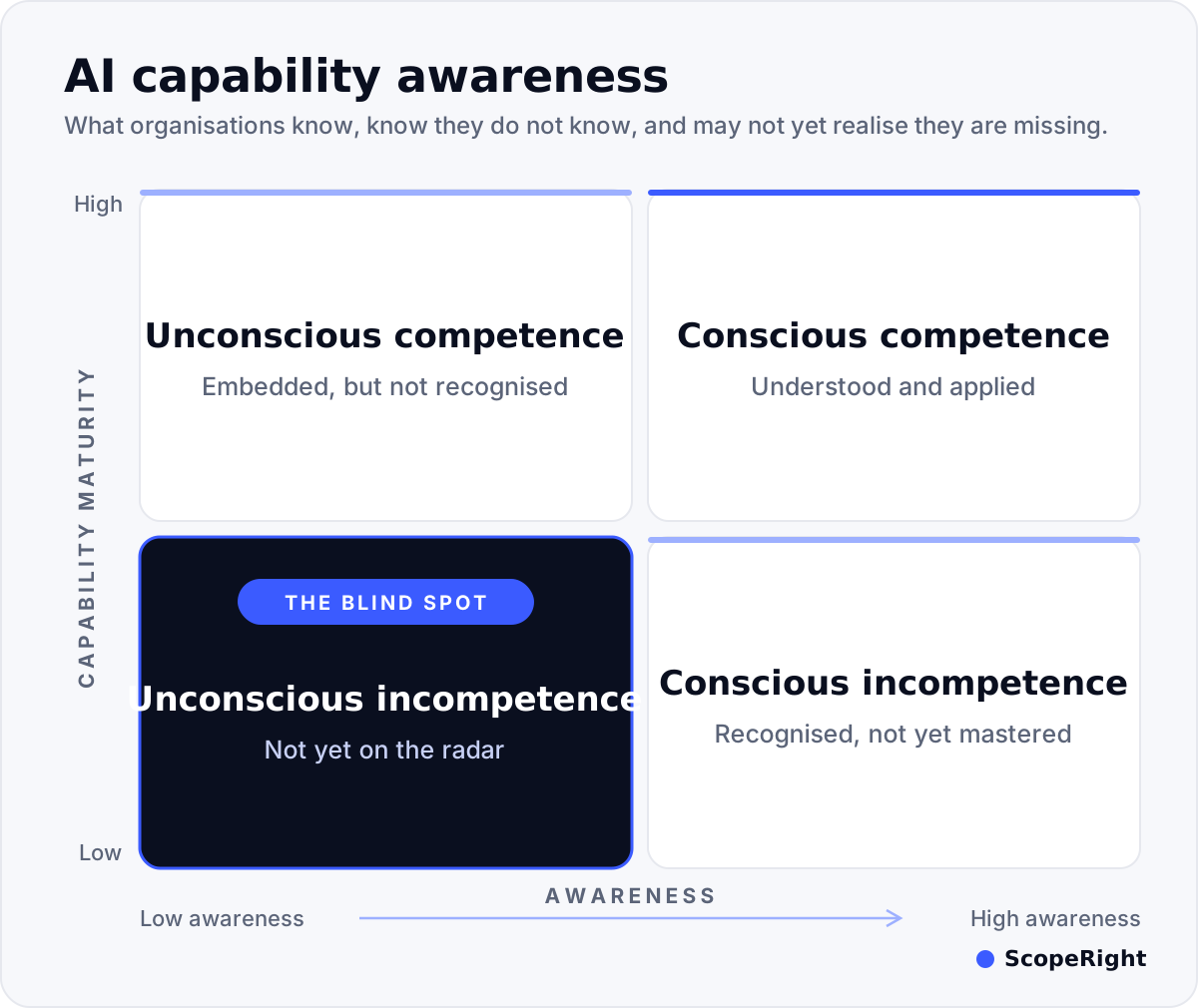
Conscious competence is where governance works as intended: the team understands the opportunity and can apply the relevant solutions, even if it still takes deliberate effort and specialist involvement.
Conscious incompetence is uncomfortable but healthy: the organisation sees the gap and can plan for it — build, buy, partner or wait.
Unconscious competence is the pleasant surprise: relevant capabilities already embedded in processes or ways of working, just never recognised or managed as strategic AI assets.
And then there is unconscious incompetence: the opportunities, risks and required capabilities nobody inside the organisation has recognised yet.
This is the quadrant that matters most — and the one no internal process can reach. Asking employees to submit more AI ideas produces more of what they already see. It cannot produce the question no one knows to ask.
One caveat: this is not a maturity score, and it is not a diagnosis of any single organisation. Different business domains, teams and opportunities sit in different quadrants at the same time. The point of the model is to make one thing discussable: part of your AI landscape is invisible from the inside.
The cost of the blind spot
For years, the standard worry about AI was moving too slowly. That worry is now outdated.
The greater risk is committing months of time, budget and organisational energy to a direction that has already been overtaken — building something that is becoming obsolete, that has been solved more effectively elsewhere, that rests on technical assumptions from two model generations ago, or that crowds out a more valuable opportunity nobody surfaced.
The most expensive AI project may not be the one that fails. It may be the one that works exactly as designed — and solves yesterday's problem.
Blind spots are rarely visible at the moment they become expensive, because outdated assumptions harden into things that are hard to reverse: architecture decisions, procurement criteria, data programmes, implementation roadmaps, build-versus-buy decisions and the governance model itself. By the time the gap is obvious, it is embedded.
That is why vague ambition is not the only failure mode. A precisely scoped project built on yesterday's assumptions fails slower, and costs more.
What an Outside-in AI Landscape Scan actually does
This is the demand we increasingly see from organisations with mature internal AI processes — not more ideation, but structured external sensing. We deliver it as Outside-in Scan: an Outside-in AI Landscape Scan for one business domain at a time.
It is not a generic trend report, and not a catalogue of AI use cases.
It starts inside: a specific business domain, its strategic priorities, current initiatives, existing experiments and real constraints around data, platforms and adoption. Then it looks outward, deliberately beyond the organisation's current field of view — relevant industries, adjacent sectors, functional peers, AI-native organisations, more mature international markets, and emerging AI, automation and agentic technology patterns.
The output is not inspiration. It is decisions:
- blind spots surfaced and named
- opportunities outside the current field of view
- assumptions challenged before they become architecture
- validation of whether chosen directions remain future-ready
- durable developments separated from hype
- a prioritised shortlist: explore, accelerate, reconsider or stop
From there, the most promising opportunities can move into a normal, evidence-based path: a scoping workshop to define them properly, or a Minimal Viable Agent sprint to test the riskiest assumption before serious budget is committed.
One foot inside. One foot outside.
The conclusion is not that internal knowledge is the problem. It is the opposite: inside knowledge is what makes any AI initiative relevant. Internal teams understand the business priorities, the customers, the processes, the data, the constraints and what adoption actually takes.
But inside knowledge has a shelf life, and in AI that shelf life is shortening.
One foot inside the organisation. One foot continuously outside it.
Inside creates relevance. Outside prevents internal knowledge from quietly becoming a limitation. The strongest AI governance models will not choose between the two — they will make external sensing as routine as internal prioritisation.
You cannot fix what you cannot see. But you can decide, deliberately, to go looking.
Frequently asked questions
- What is an Outside-in AI Landscape Scan?
- A structured external benchmark for one business domain. It starts from the domain's strategic priorities, current initiatives and constraints, then looks outward — at relevant industries, adjacent sectors, functional peers, AI-native organisations and emerging agentic technology patterns — to surface blind spots, challenge assumptions and produce a prioritised shortlist of what to explore, accelerate, reconsider or stop. At ScopeRight this is delivered as the Outside-in Scan service, typically completed in two to three weeks per business domain.
- What are AI blind spots?
- Opportunities, risks or capabilities an organisation cannot yet see because nobody inside knows to ask about them. Internal ideation processes are good at surfacing known problems and known technologies; blind spots sit outside that field of view — in adjacent industries, AI-native operating models, or capability shifts that quietly invalidate current plans.
- What is the AI capability awareness matrix?
- A simple 2x2 model that maps awareness against capability maturity, producing four states: unconscious incompetence (blind spots), conscious incompetence (known gaps), conscious competence (applied with effort) and unconscious competence (embedded but unrecognised). It is a conversation tool, not a scientific diagnostic — different domains, teams and opportunities sit in different quadrants at the same time.
- How is an outside-in benchmark different from an AI maturity assessment?
- A maturity assessment scores how well an organisation runs what it already does. An outside-in benchmark asks a different question: what is happening outside the organisation that should change what it does next? It is anchored in one business domain and ends in decisions — explore, accelerate, reconsider or stop — rather than a score.
- Does external benchmarking replace internal AI teams or governance?
- No. Internal teams hold the knowledge that makes any AI initiative relevant: the processes, data, customers and constraints. An outside-in perspective complements that governance by adding structured external sensing — it sharpens internal decision-making rather than auditing or replacing it.
What might your organisation not yet be seeing?
ScopeRight's Outside-in AI Landscape Scans help business and technology teams identify blind spots, challenge current assumptions and understand what emerging AI capabilities could mean for a specific business domain. Start with a free 30-minute intake.