By Frideric Pétré, Founder of ScopeRight and Co-founder of Nova
Persistent AI agents keep context, work through your tools and bring finished work back for review. Viktor, Grok Bot and OpenAI's Dots have turned that idea into products a team can try this quarter. For business leaders the useful question is no longer whether agents work, but which workflows to hand over, on what terms, and whether to use, extend, buy or build.
What is a persistent AI agent?
A persistent AI agent is software that takes a brief, keeps the context of the work between sessions, acts through connected applications and returns a result for a person to review. A chat assistant answers and stops. A persistent agent continues.
That is a change in the relationship with software. We are learning to delegate outcomes, not only to ask questions.
What do Viktor, Grok Bot and Dots actually do?
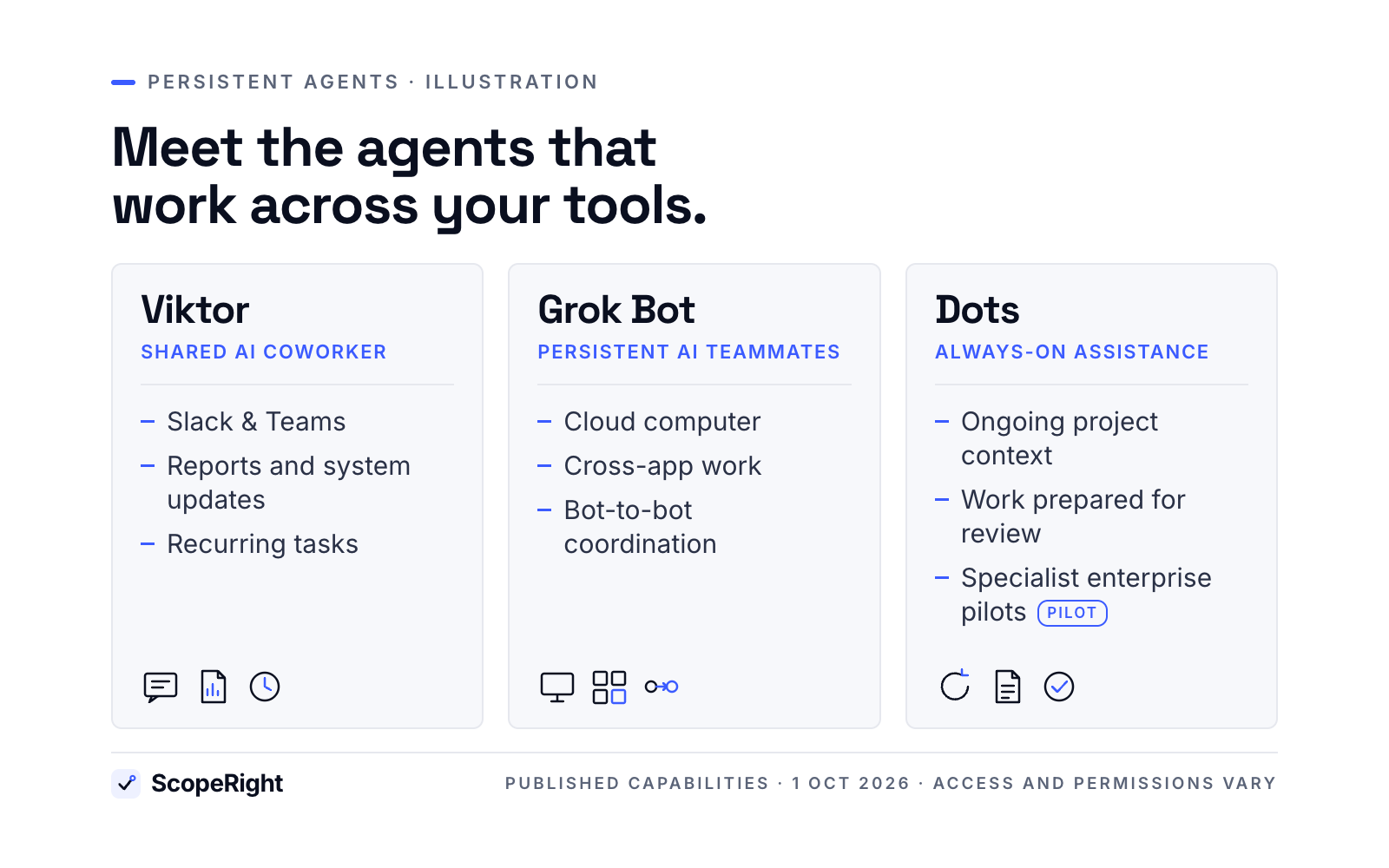
| Viktor | Grok Bot | Dots (OpenAI) | |
|---|---|---|---|
| How it presents itself | A shared AI coworker | Persistent AI teammates | Always-on agents |
| Where it works | Inside Slack and Microsoft Teams | On its own cloud computer, across apps and websites | Across connected applications, between conversations |
| Representative work | Data analysis, reports, system updates, recurring tasks | Account research, CRM updates, outreach drafts, operations | Progressing projects, revising materials, preparing fixes for review |
| Working together | Shared by the whole team in a channel | Bots exchange context and hand tasks to one another | Specialist dots for defined responsibilities, in enterprise pilots |
Viktor lives in the workspace a team already uses. Someone mentions it in a channel, gives it a job and receives the output there: an analysis, a report, an updated system. Its maker describes it as an AI coworker for the whole team, not a tool for one power user.
Grok Bot gives each Bot its own computer in the cloud. Bots sign in to the tools a company uses, including ones without a clean integration, keep working when their owner is offline and come back when something needs approval. Several Bots can share context in a thread and pass work between them.
Dots, which OpenAI announced on 29 September 2026, carry the context of a project across conversations and keep moving it forward. The launch starts with a primary dot. Specialist dots for organisational responsibilities are being piloted with enterprises, so a general "team of dots" should not be assumed to be available to everyone.
These descriptions reflect what the vendors have published, not our own performance test. What each product can do in your company depends on the tools you connect, the permissions you grant and the plan and region you are in.
What changes: delegate the workflow, keep the judgment
The interesting part is not any single feature. It is that the handover between steps no longer needs a person.
Much of office work is connecting systems by hand: read the email, look up the account, check the spreadsheet, update the CRM, ask a colleague. An agent can carry that sequence. The person sets the brief at the start and approves the commitment at the end.
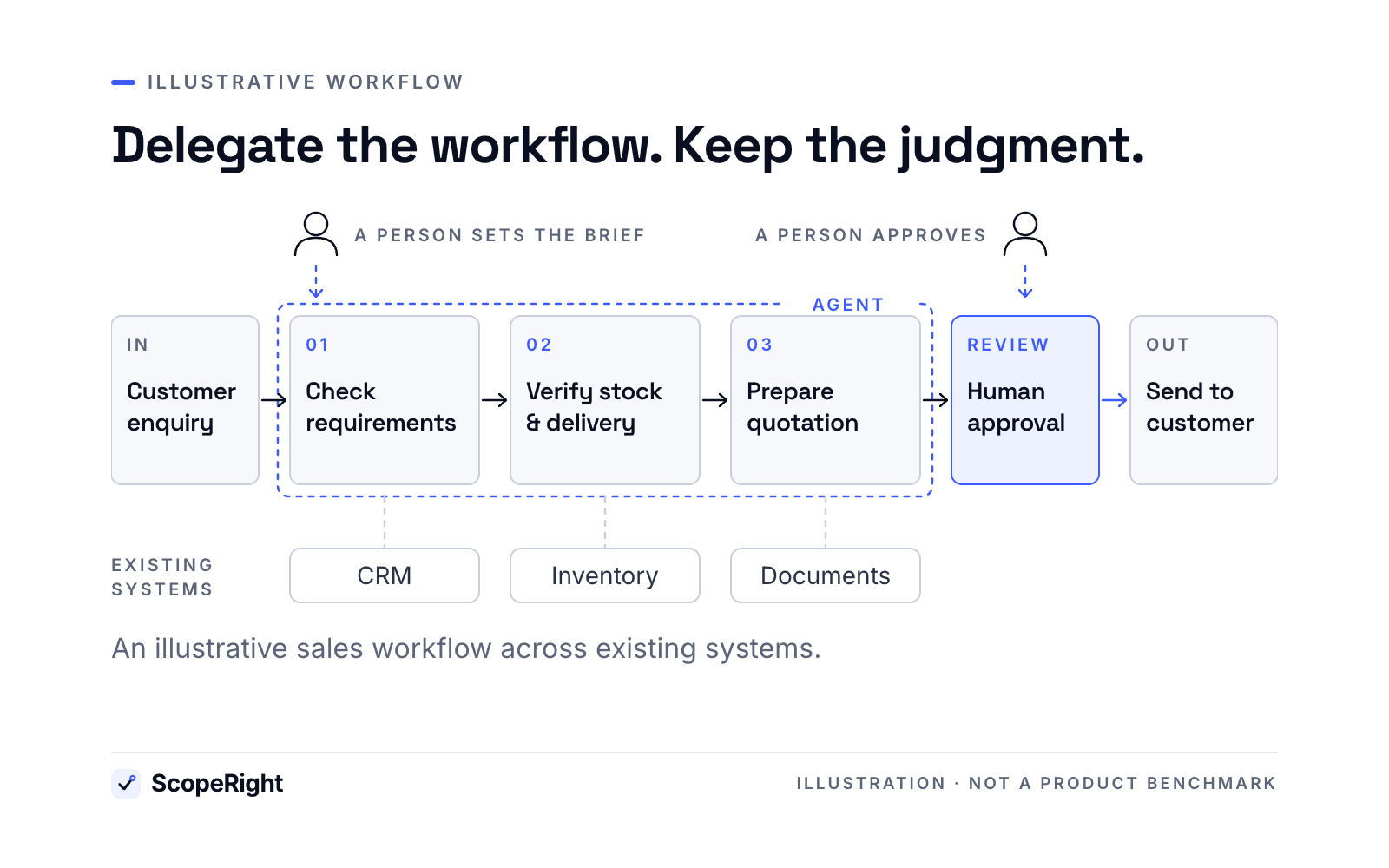
Take a sales enquiry. The agent checks the requirements, verifies stock and delivery, and prepares a quotation. Nothing leaves the building until a person has approved it. This is an illustrative workflow, not a benchmark, and not every platform supports each step out of the box. It shows where the human role moves to: direction at the front, judgment at the end.
That only works if "good" has been written down. An agent can send a confident, well-formed quotation with the wrong delivery date. The tool worked; the task failed. This is why we treat AI agent evals as part of scoping: if you cannot describe good performance, you are not ready to delegate the task.
Why now? Useful AI is becoming cheaper to run
Stanford's AI Index 2025 reports that the price of querying a model at GPT-3.5 level on the MMLU benchmark fell from $20 to $0.07 per million tokens between November 2022 and October 2024, a reduction of more than 280 times.
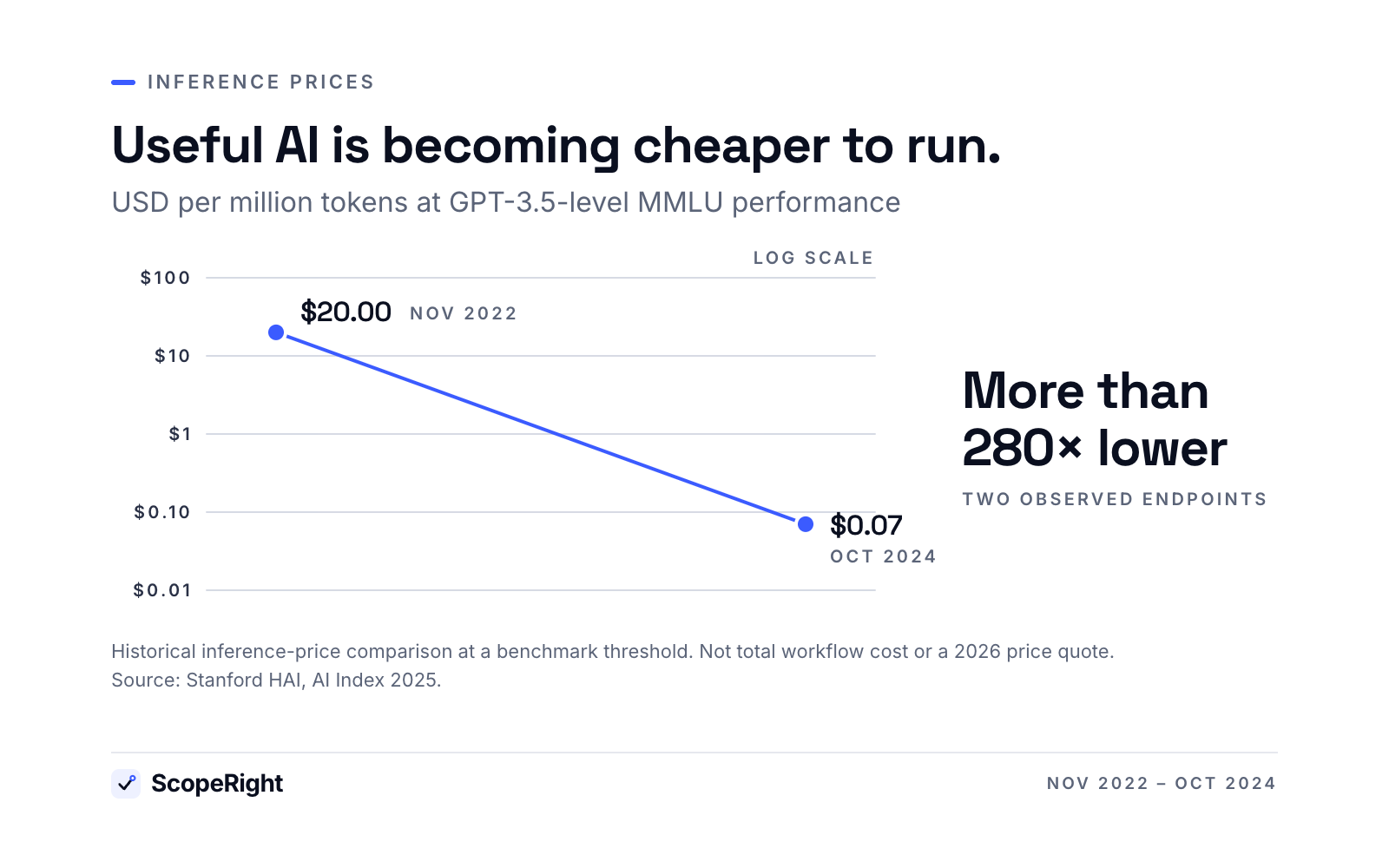
Read that number carefully. It is a historical price comparison at one benchmark threshold. It is not the cost of a workflow and it is not a price quote for 2026. Integration, verification, hosting and operations still have to be paid for.
What it does change is the list of workflows worth considering. Work that was too small, too varied or too infrequent to automate two years ago may now carry a business case.
Which workflows should you delegate first?
Agents make it tempting to start with the product and look for a use. We would start one decision earlier. Five questions separate a good first candidate from an expensive experiment:
- Does it recur? A workflow that happens every day teaches you more in a month than one that happens once a quarter.
- Is the finished result clear? "A quotation ready for approval" is a result. "Help the sales team" is not.
- Can the agent be given access? The systems involved must be reachable, and you must be comfortable with the permissions that requires.
- Where does a person approve? Any step that commits the company, to a price, a date or a customer, needs a named approval point.
- How will you know it is good? Agree the criteria and a handful of real cases before the first run.
If these are hard to answer, the scope is not ready yet. That is the work of an AI Scope Workshop, and it is cheaper to do before a licence is signed than after. Our checklist on how to scope an AI project covers the same ground in more detail.
Use, extend, buy or build?
Once the workflow is clear, the route usually follows from it. The architecture follows the scope, not the other way around.
| Route | Fits when | Watch for |
|---|---|---|
| Use an agent you already have access to | The work is generic and runs across standard tools | Permissions, data access and who reviews the output |
| Extend an existing platform | The workflow is yours, but the systems are standard | How far configuration goes before it becomes custom work |
| Buy a specialist solution | A vendor already solves the scoped workflow | Lock-in, pricing as usage grows, exit terms |
| Build your own | The workflow depends on your own rules, data and expertise | Ownership of the code, operations after launch, total cost |
For many teams the first step will be to use one of these agents on a contained workflow and learn from it. That is a sensible way to build evidence. A Minimal Viable Agent does the same job when the workflow is too specific for a general product: one narrow task, real users, measured against criteria agreed in advance.
The picture changes when the work is what makes the company distinctive: compatibility rules, pricing logic, supplier knowledge, the way exceptions are handled. Then the question becomes whether that logic should live inside someone else's product or in software the company owns.
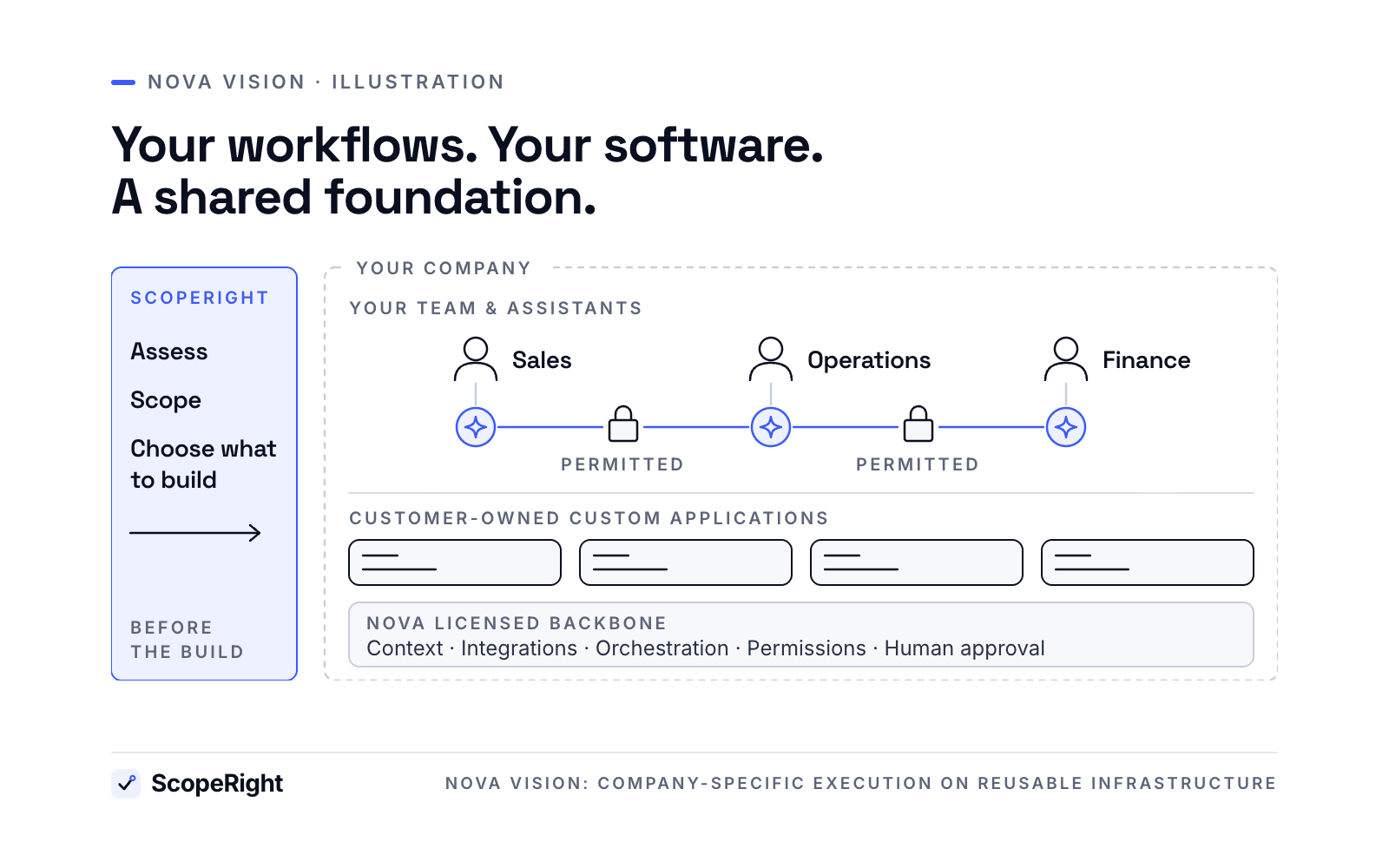
That is the direction we are taking with Nova: a reusable backbone on which a company builds its own applications and assistants, with shared context, permissions and human approval, and custom code the customer owns. The longer essay on the Nova site, agents as the electric motors of AI, sets out that argument.
A note on independence. Nova is one possible implementation partner, and I am a co-founder of it. ScopeRight's recommendation still follows the client's requirements, including existing systems, alternative vendors and internal build options, and any such interest is made visible in the decision. In many cases the right answer is an agent you can buy today.
Where does this leave a leadership team?
Viktor, Grok Bot and Dots show what delegation can look like. They do not decide what your company should delegate.
Pick one workflow. Write down the result you expect and who approves it. Try it with the simplest route that fits. Measure it. Then decide whether to scale it, change the route or stop. If you want a second opinion on where to begin, book a free intake.
Scope before solution. Evidence before scale.
Sources checked on 1 October 2026: Viktor, Grok Bot overview and launch post, OpenAI Dots launch and access notes, Stanford HAI AI Index 2025. Product descriptions reflect published vendor capabilities, not an independent performance test.
Frequently asked questions
- What is a persistent AI agent?
- A persistent AI agent keeps context between conversations, works through connected tools and continues a task over time, returning work for review. That is the difference with a chat assistant, which answers a question and stops.
- What is the difference between Viktor, Grok Bot and Dots?
- Viktor is a shared AI coworker inside Slack and Microsoft Teams. Grok Bot provides persistent Bots on a cloud computer that can coordinate with one another. OpenAI's Dots are always-on agents that carry project context between conversations, with specialist dots in enterprise pilots. Access, permissions and rollout differ per product.
- Should we adopt an off-the-shelf agent or build our own?
- Start with the workflow, not the product. Generic work across standard tools is usually served well by an existing agent. A workflow that depends on your own rules, data and approvals may justify extending a platform or building. The architecture follows the scope.
- Which workflow should we delegate to an agent first?
- Choose one that recurs often, has a clear finished result, uses systems the agent can be given access to, and has a natural point where a person approves the outcome. Define what good looks like before you delegate it.
- Does cheaper AI mean agent projects are cheap?
- No. Model inference has become much cheaper, but integration, verification, hosting and operations remain real costs. Cheaper inference widens the set of workflows worth automating; it does not remove the need for a business case.
Not sure which workflow to delegate first?
A free 30-minute intake gives you a real read on where an agent would help, and whether to use, buy or build.