There is an interesting shift happening inside private equity.
More mid-market firms are professionalising value creation beyond the traditional operating partner model. They are building internal strategy functions with a broad mandate across the investment lifecycle: support commercial diligence, translate the investment thesis into a multi-year value creation plan, work with portfolio leadership on strategic priorities, codify repeatable playbooks, bring best practices across the portfolio and manage external strategy firms and specialist vendors.
The direction fits the broader shift in the industry. Bain's Global Private Equity Report 2026 describes a new era in which returns depend on operational value creation rather than leverage and multiple expansion — and in which delivering repeatable alpha "demands heavy investment in specialization, mission-critical capabilities, broad ecosystems, and world-class talent."
It is difficult to argue with the logic.
If a fund repeatedly buys the same type of strategic thinking from outside, why not build more of that capability internally?
I think they should.
But there is a catch.
The most sophisticated PE firms may be institutionalising the traditional consulting model at exactly the moment when AI is starting to change what a value creation function should actually do.
1. You may be hiring the right people for the wrong operating model
Look at what a strong central strategy team is typically expected to do.
Build fact bases. Run strategic planning sessions. Develop VCPs. Help portfolio companies prioritise growth initiatives. Support diligence. Select external advisers. Turn lessons into frameworks and reusable playbooks.
All valuable.
But structurally, it still follows a familiar model:
analyse the business, define the strategic priorities, turn them into initiatives, then mobilise management teams and external specialists to execute them.
That model has served private equity well.
The question is whether it is still sufficient.
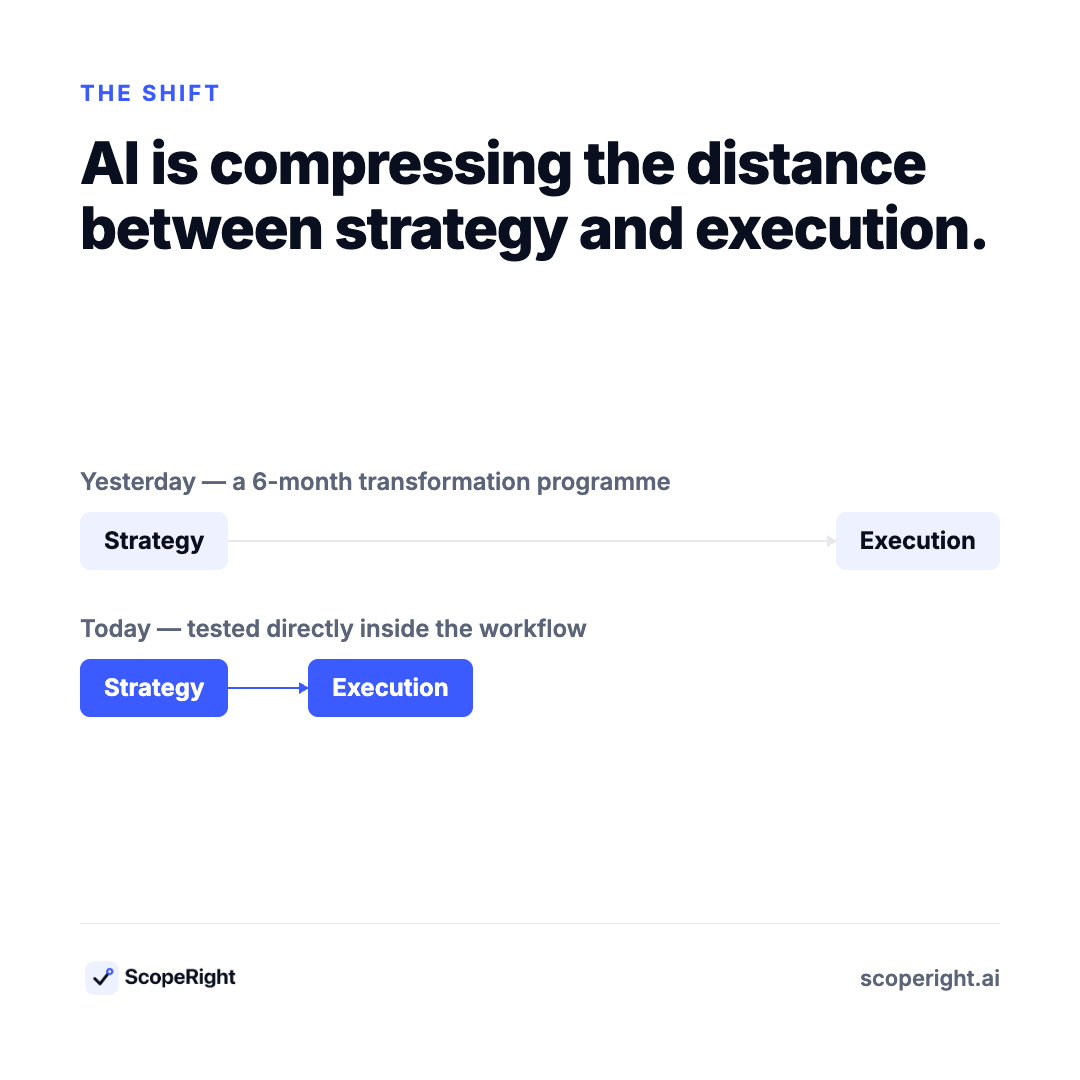
AI is starting to compress the distance between strategy and execution. Some of the strategic questions that would previously have become a six-month transformation programme can increasingly be tested directly inside the workflow.
Take commercial excellence.
The traditional strategic initiative might be to improve account prioritisation, increase cross-sell or raise seller productivity.
Today, the more useful question may be much more concrete:
Could an AI-enabled workflow continuously research accounts, detect commercial signals, identify whitespace, prepare the first action and learn from what salespeople actually do with those recommendations?
The same applies to pricing, procurement, finance, service operations and knowledge work.
That changes the job of a value creation team.
It is no longer enough to know what the company should improve.
The team increasingly needs a way to determine what should work differently inside the business, whether AI can materially change it and how quickly that hypothesis can be proven or killed.
That is a different capability.
And adding an "AI expert" to the existing operating model does not automatically create it.
2. A value creation plan full of initiatives is no longer enough
The VCP is one of the most important artefacts in private equity value creation.
It translates the investment thesis into a set of concrete priorities: growth, margin expansion, pricing, working capital, M&A, organisation, technology.
But look underneath many of those priorities and you quickly arrive at workflows.
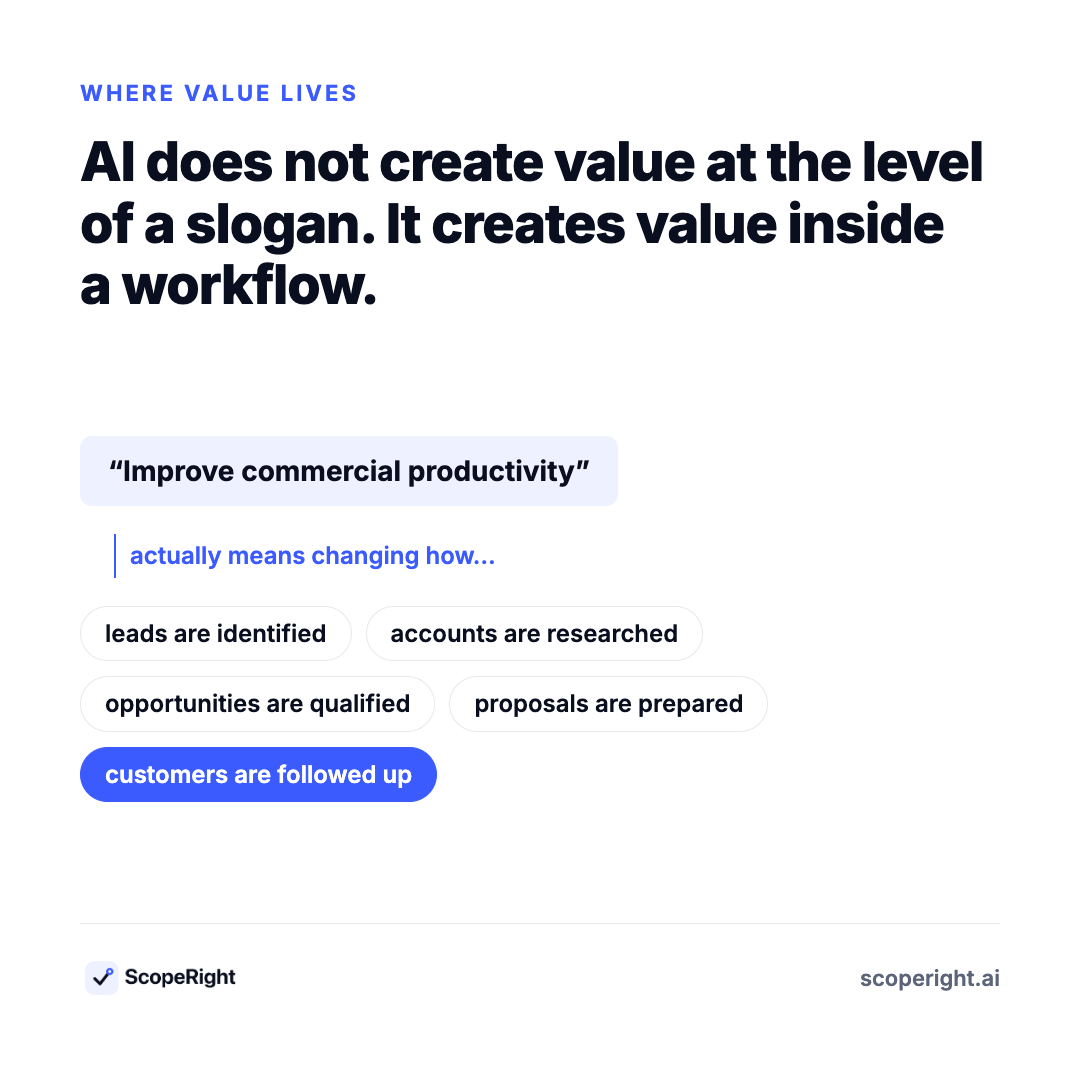
"Improve commercial productivity" ultimately means changing how leads are identified, accounts are researched, opportunities are qualified, proposals are prepared or customers are followed up.
"Reduce SG&A" eventually means changing how finance, HR, legal, procurement or customer service work gets done.
"Improve pricing" means changing the quality, timing or consistency of pricing decisions.
That matters because AI does not create value at the level of a strategic slogan.
It creates value — or fails to create it — inside a workflow.
This is why I believe AI use-case discovery in private equity should start from the value creation plan, but should not stop there.
At ScopeRight, we use a fairly simple progression.
Govern. Scope. Mobilise.
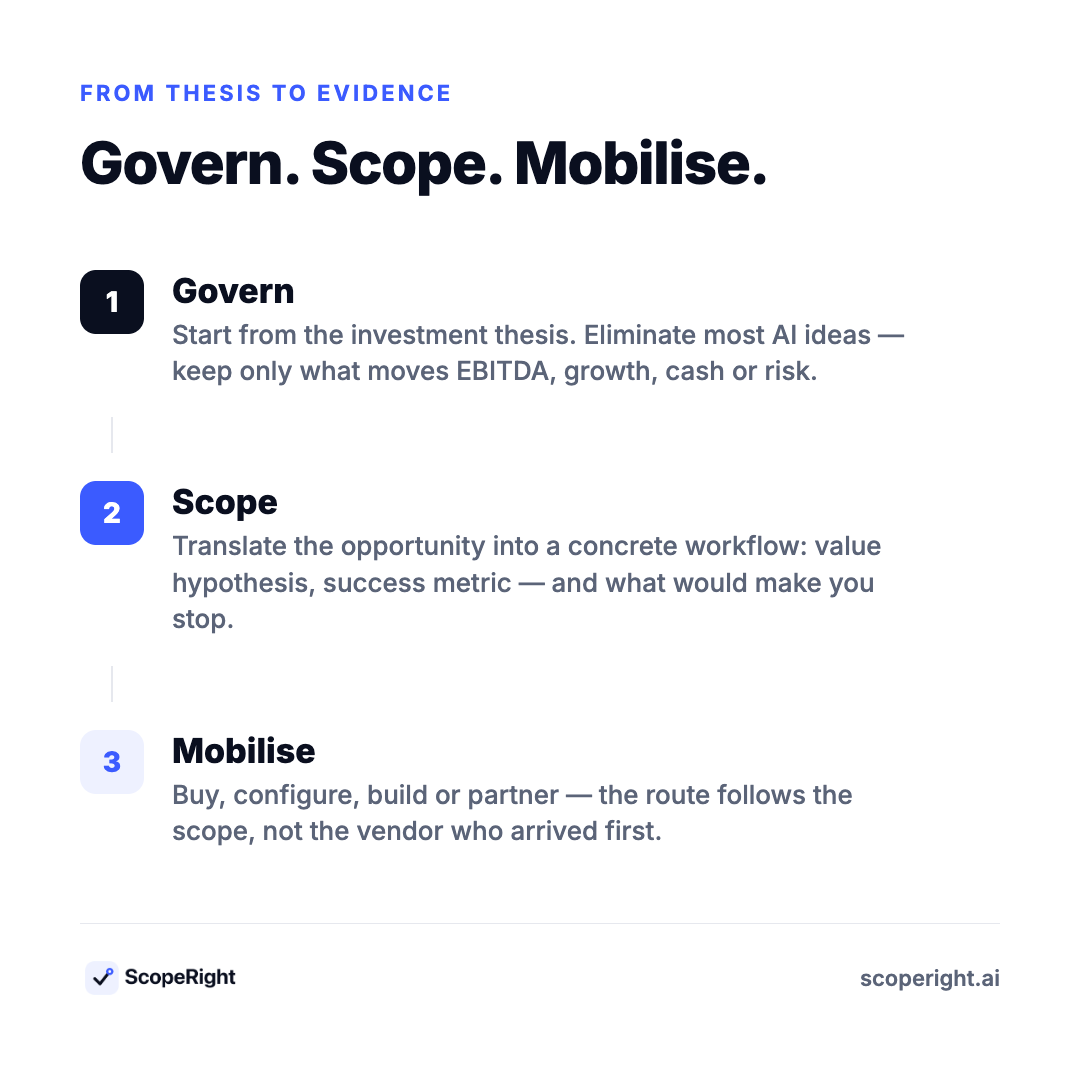
Under Govern, you start from the investment thesis and the value drivers.
Which operating problems genuinely matter? Where is there enough economic value to justify management attention? Which AI use cases are strategically relevant? Which ones are attractive PowerPoint ideas but unlikely to move EBITDA, growth, cash or risk?
The purpose is not to generate a list of fifty AI ideas.
It is to eliminate most of them.
Then comes Scope.
A promising opportunity has to be translated into something much more concrete than "deploy an agent". (This is the same discipline we describe in how to scope an AI project — it applies just as much inside a portfolio.)
What workflow changes?
Who is involved?
What triggers it?
Which systems and data does it rely on?
Where can AI make a decision or take an action?
Where is human judgement still required?
What is the value hypothesis?
What metric will tell us whether it actually works?
And what would make us stop?
Sometimes the exercise already shows that the use case is not worth pursuing.
That is a successful outcome.
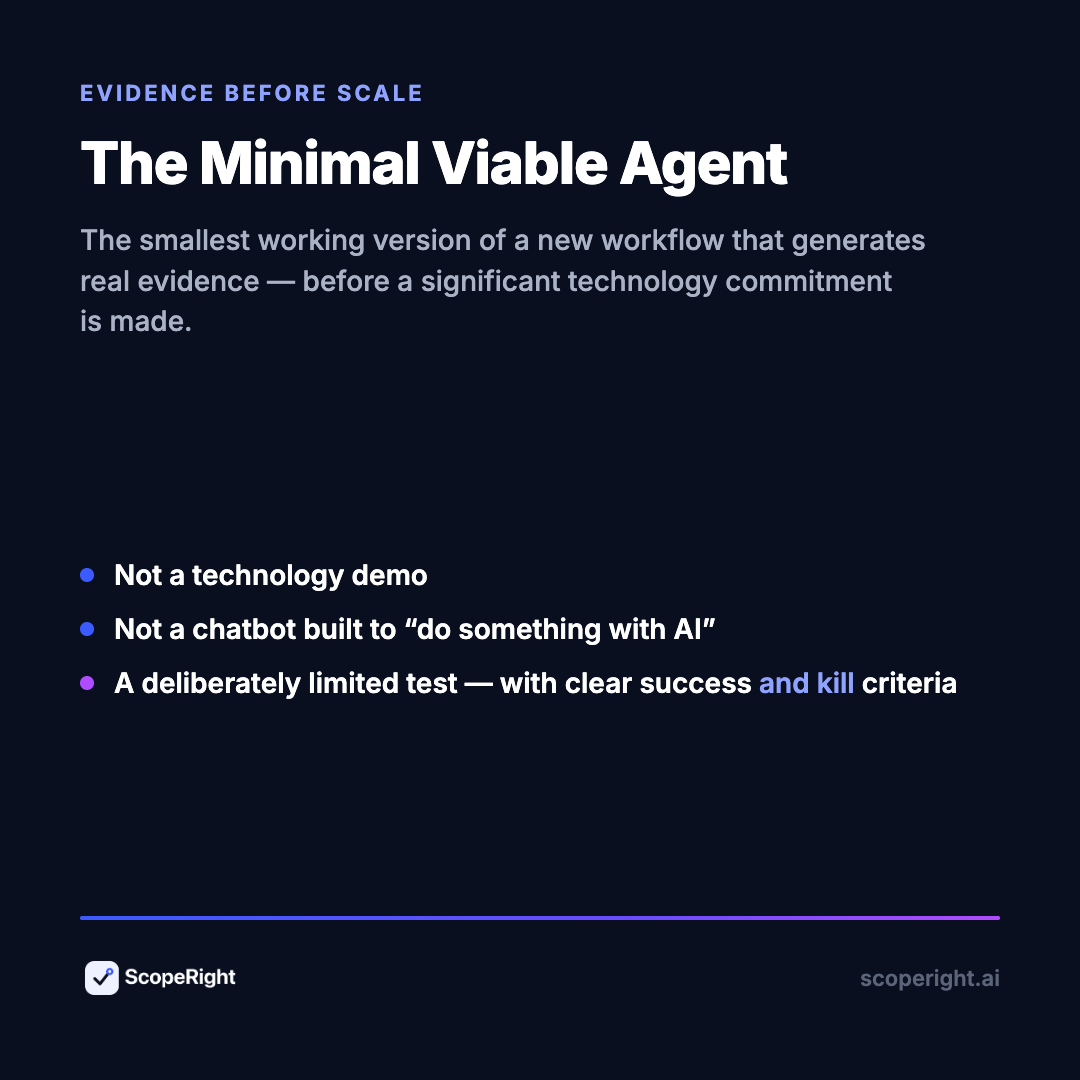
For the strongest cases, you can go one step further with a Minimal Viable Agent: the smallest working version of the new workflow that can generate real evidence before a significant technology or implementation commitment is made.
Not a technology demo.
Not a chatbot built because somebody wanted to "do something with AI".
A deliberately limited test of whether a different way of operating produces enough value to deserve scaling.
The discipline matters more than it might seem. MIT's State of AI in Business 2025 research found that roughly 95% of corporate GenAI pilots deliver no measurable P&L impact — largely because they are never embedded in a real workflow. Evidence, kill criteria and workflow specificity are what separate the other 5%.
Only then does Mobilise begin.
Do we buy existing software?
Configure a specialist solution?
Build something proprietary?
Bring in a delivery partner?
The implementation route follows the scope, rather than the scope being dictated by whichever vendor reached the portfolio company first.
This may sound like an AI methodology.
I think it is increasingly part of basic value creation discipline.
3. Don't build an internal AI factory. Build a better decision system.
There is another trap here.
Once PE firms recognise that AI needs more structure, the instinct can be to centralise it.
Build the AI team. Create the platform. Select the preferred stack. Hire engineers. Standardise implementation across the portfolio.
For some firms, parts of that will make sense.
But I would be cautious.
A 70-person industrial company, a professional-services platform and a vertical SaaS business do not have the same workflows, technology estate, data or organisational readiness.
Trying to execute everything centrally can become expensive very quickly.
The much more interesting thing to centralise is the decision system — portfolio AI governance rather than a portfolio AI factory.
A fund can create a common way to identify opportunities, describe them, evaluate and prioritise AI use cases across portfolio companies, establish evidence requirements, apply kill criteria and choose the implementation path.
It can also capture what was learned.
That last part matters more than it first appears.
Imagine that one portfolio company has already investigated AI-supported proposal generation.
It has learned which data is actually needed, where hallucination becomes dangerous, which part of the workflow salespeople will accept, what level of human review is required, what integration proved difficult and which vendor made attractive promises but could not deliver.
Why should the next portfolio company start from zero?
The answer is not necessarily to deploy exactly the same software.
The reusable asset may be the scope.
Or the business case.
Or the architecture pattern.
Or a Minimal Viable Agent.
Or a vetted technology partner.
Or simply the evidence that a certain approach should not be repeated.
This is where the portfolio itself can become an advantage.
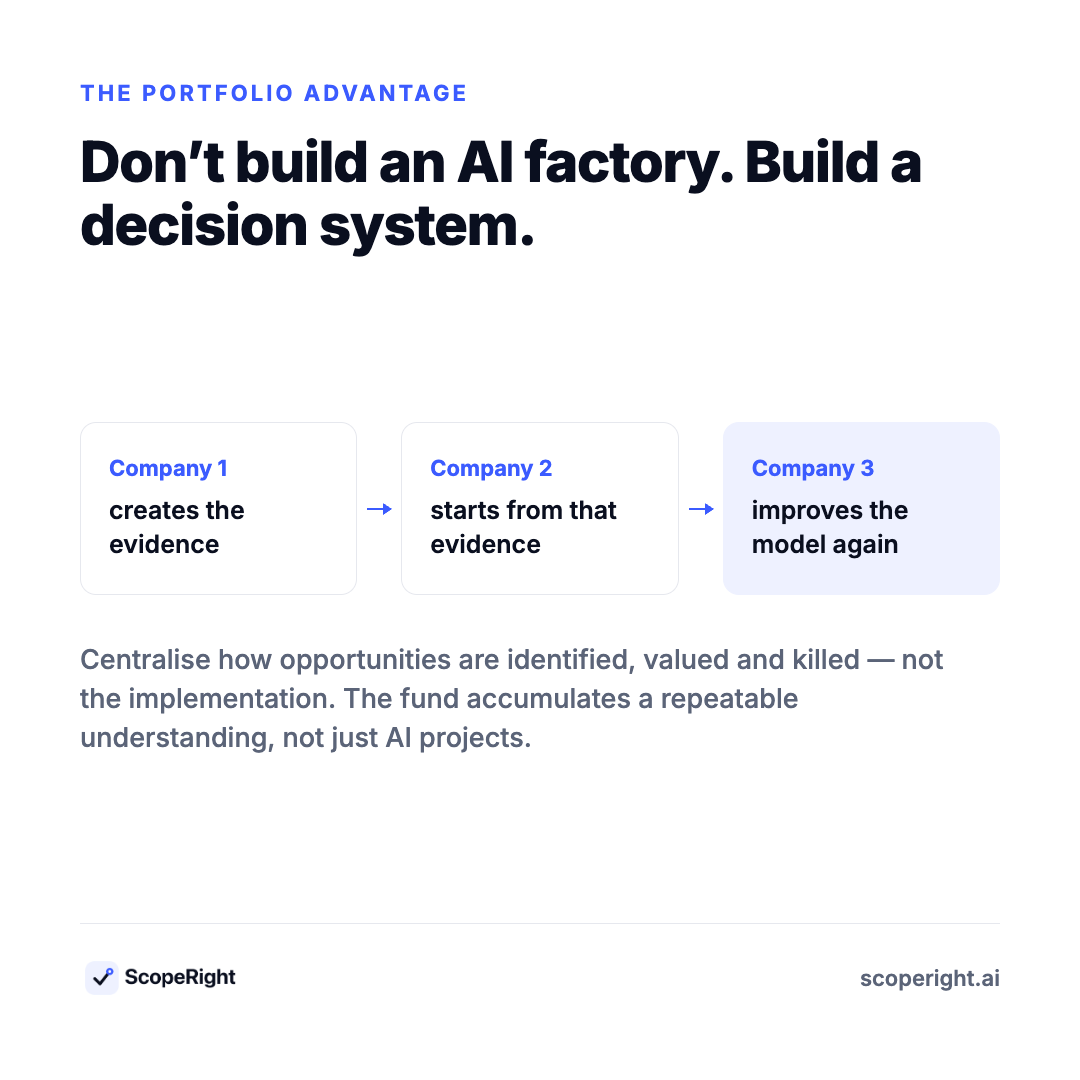
One company creates evidence.
The next starts with that evidence.
The third improves the model again.
Over time, the fund is not merely accumulating AI projects. It is accumulating a much more valuable asset: a repeatable understanding of how technology can change operating performance across the portfolio.
That is why I think the current build-out of internal PE strategy teams is important.
The direction is right.
But the mandate may need to evolve.
The strongest value creation team of the next decade will still need excellent strategic thinkers. It will still need rigorous analysis, strong VCPs, commercial judgement and the ability to work with management teams.
But it will also need to get much closer to the operating reality.
Not by becoming the implementation team.
By becoming exceptionally good at moving from investment thesis to operating problem, from operating problem to evidence, and from evidence to the right execution path.
Private equity has spent decades building repeatable systems for making better investment decisions.
The next opportunity is to become just as systematic about making better operating decisions.
And that may prove far more valuable than building another central AI team.
This is the gap ScopeRight is designed to fill: an independent AI operating capability for private equity that works alongside internal strategy teams — governing the use-case portfolio, scoping workflows and generating evidence before scale — without owning the implementation or selling the software.
Frequently asked questions
- What should an AI operating capability in private equity actually own?
- At fund level, the highest-leverage activities are typically portfolio AI governance, AI use-case prioritisation, business-case standards, evidence requirements, reusable knowledge and the build-buy-partner decision. Portfolio companies should generally continue to own their processes, data, people, adoption and implementation outcomes.
- How does AI fit into a private equity value creation plan?
- AI should not sit beside the VCP as a separate innovation agenda. Start with the existing value drivers — revenue growth, margin, pricing, productivity, cash or risk — and identify the workflows that need to perform differently to achieve them. AI is then one possible mechanism for changing those workflows.
- What is a Minimal Viable Agent?
- A Minimal Viable Agent is the smallest AI-enabled version of a real workflow needed to test whether an AI use case creates enough operational and economic value to justify further investment. It is designed to generate evidence before scale, with clear success and kill criteria.
- Should a PE firm build a central AI team for its portfolio companies?
- Usually not as a central implementation factory. Portfolio companies differ too much in workflows, systems, data and readiness for one team to execute everything centrally. The more valuable thing to centralise is the decision system: a shared way to identify AI opportunities, evaluate business value, set evidence requirements, apply kill criteria, choose the implementation path and reuse what each portfolio company learns.
- What is the difference between a traditional operating partner and an AI operating partner?
- A traditional operating partner drives value creation through strategic priorities, playbooks and management support. An AI operating partner adds a workflow-level discipline: determining where AI can materially change how a portfolio company operates, scoping those use cases, generating evidence quickly and deciding whether to build, buy or partner. It is an operating and capital-allocation role, not a technology procurement role.
- Should a portfolio company hire a full-time Chief AI Officer or use fractional AI leadership?
- Most mid-market portfolio companies do not have enough decision volume to justify a full-time Chief AI Officer early on. A fractional AI operating capability — shared across the portfolio or brought in as an independent partner — can run governance, scoping and evidence generation part-time, and the role can be converted to a full-time hire once the pipeline of proven use cases demands it.
From investment thesis to operating evidence — without building another central AI team.
ScopeRight works alongside PE value creation teams as an independent AI operating capability: prioritising use cases from the VCP, scoping workflows and proving them with Minimal Viable Agents. Start with a free 30-minute intake.