Private equity firms do not have an AI tooling problem.
They have a value-creation problem.
The market is filling rapidly with AI platforms, copilots, automation vendors and increasingly sophisticated agents. That makes it tempting to approach AI the same way companies have approached other technology waves: select the right platform, deploy it across the organisation and look for adoption.
For private equity, that is often the wrong starting point.
AI value creation in private equity is an operating capability: identify a valuable workflow, scope how AI should change it, generate evidence in the real operation, and only then decide what deserves capital and scale.
That distinction matters.
Choosing technology is relatively easy once the problem is clear. Determining which problems are worth solving, what the redesigned workflow should look like, and whether to build, buy or partner is where much of the investment logic is actually decided.
This is why ScopeRight approaches AI value creation from the operating side first.
Not: Which AI platform should we roll out?
But:
Where could AI materially change how this company operates — and how do we prove it before committing to scale?
Search behaviour suggests this question is moving higher on the agenda. Google Keyword Planner data captured in August 2026 across Belgium, the Netherlands, UK and US classified interest around AI value creation in private equity as strongly rising, with top-of-page commercial bids reaching €13.84.
That is not proof that a particular AI strategy works. It is evidence that PE buyers are actively evaluating the category.
The more important question is what they should evaluate.
What "AI value creation" actually means in a PE context
AI value creation is often collapsed into a list of technologies:
- copilots;
- workflow automation;
- document intelligence;
- AI search;
- sales agents;
- customer-service agents;
- AI-enabled diligence tools;
- proprietary models.
Those capabilities can be useful.
But a tool is not a value-creation thesis.
For an operating partner, the real question is whether AI can improve the economics or strategic position of a portfolio company by changing how an important workflow operates.
That might involve productivity.
It might involve speed.
It might involve improving decision quality, serving customers differently, increasing commercial capacity, removing operational bottlenecks or enabling something the organisation could not realistically do before.
The starting point should therefore be the workflow and its economic relevance — not the technology category.
This changes the conversation from:
"Where can we use AI?"
to:
"Which operating problems are valuable enough to redesign with AI?"
That sounds like a subtle difference.
It isn't.
It determines whether AI becomes another portfolio of disconnected experiments or an actual operating capability.
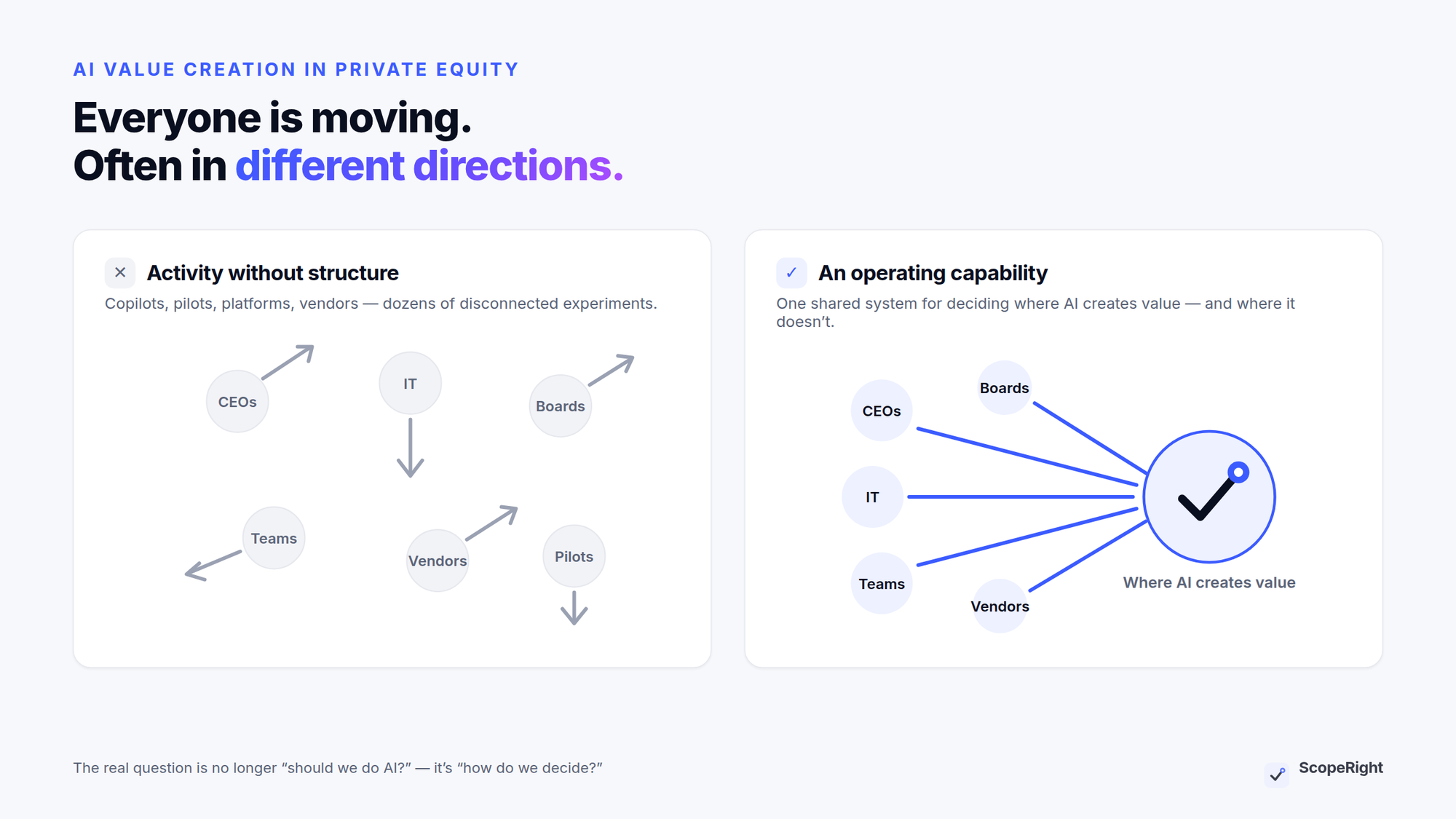
The tooling trap: why buying an AI platform doesn't create value on its own
Search for the "best private equity AI tools" and you will find a growing universe of software promising to improve diligence, portfolio monitoring, financial analysis, reporting, sourcing and operations.
Some will be excellent products.
That still does not answer the operating question.
Software can provide capability. It cannot automatically determine where that capability creates the most value inside a specific portfolio company.
A platform does not know:
- which workflow is strategically important;
- where the real bottleneck sits;
- which exceptions make the workflow difficult;
- what humans should continue deciding;
- what data is sufficiently reliable;
- which systems need to interact;
- whether a standard product can accommodate the operating model;
- or whether the economics justify changing the workflow at all.
This is where technology-first AI programs often reverse the correct sequence.
They buy capability first.
Then they search for use cases.
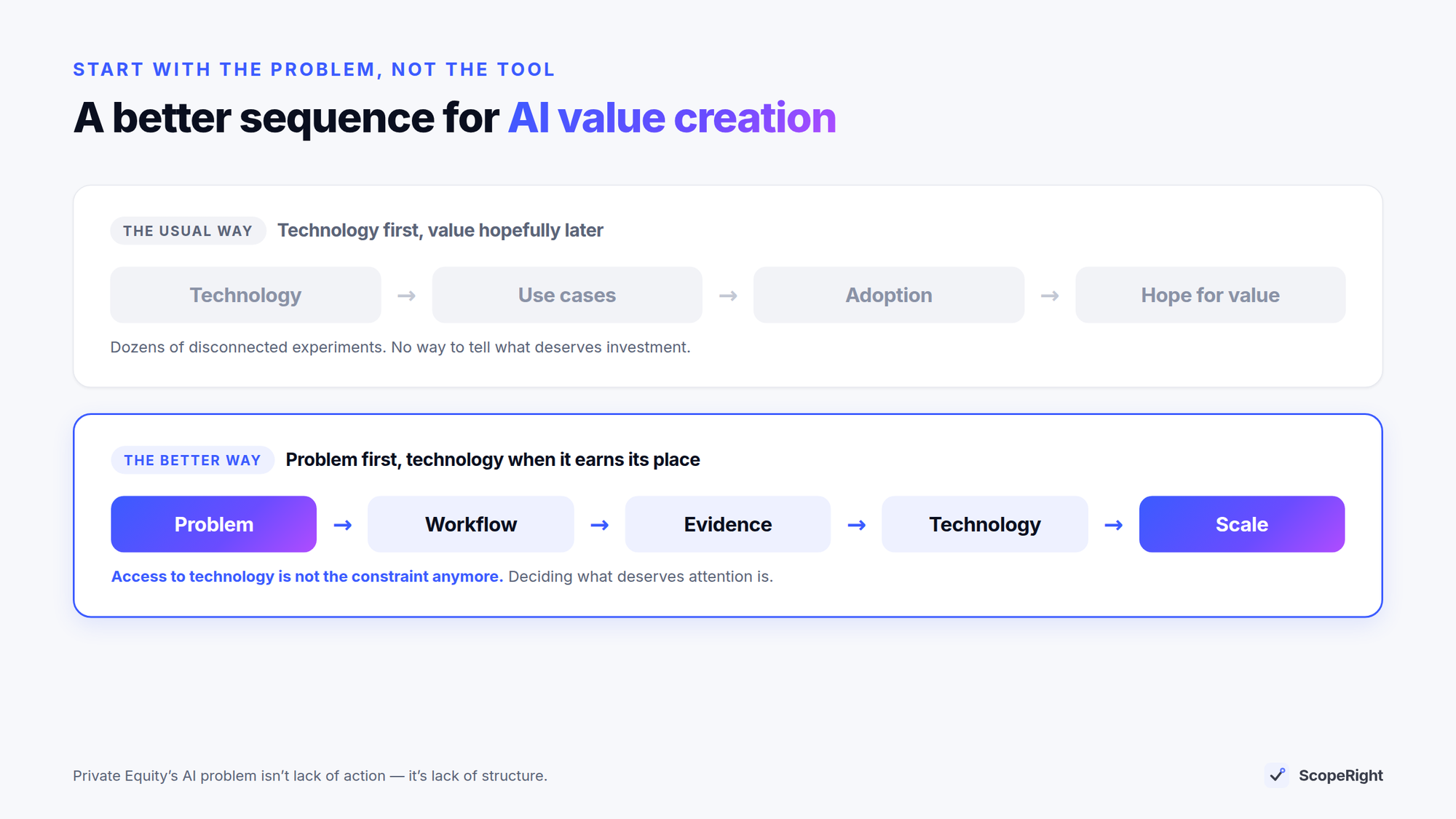
A stronger sequence is:
Problem → Workflow → Evidence → Technology → Scale
not:
Technology → Use cases → Adoption → Hope for value
For private equity, that distinction is particularly relevant because capital allocation sits behind every technology decision.
The objective is not maximum AI adoption.
The objective is better companies.
AI value creation in private equity is an operating-capability question
A repeatable AI value-creation capability requires more than vendor selection.
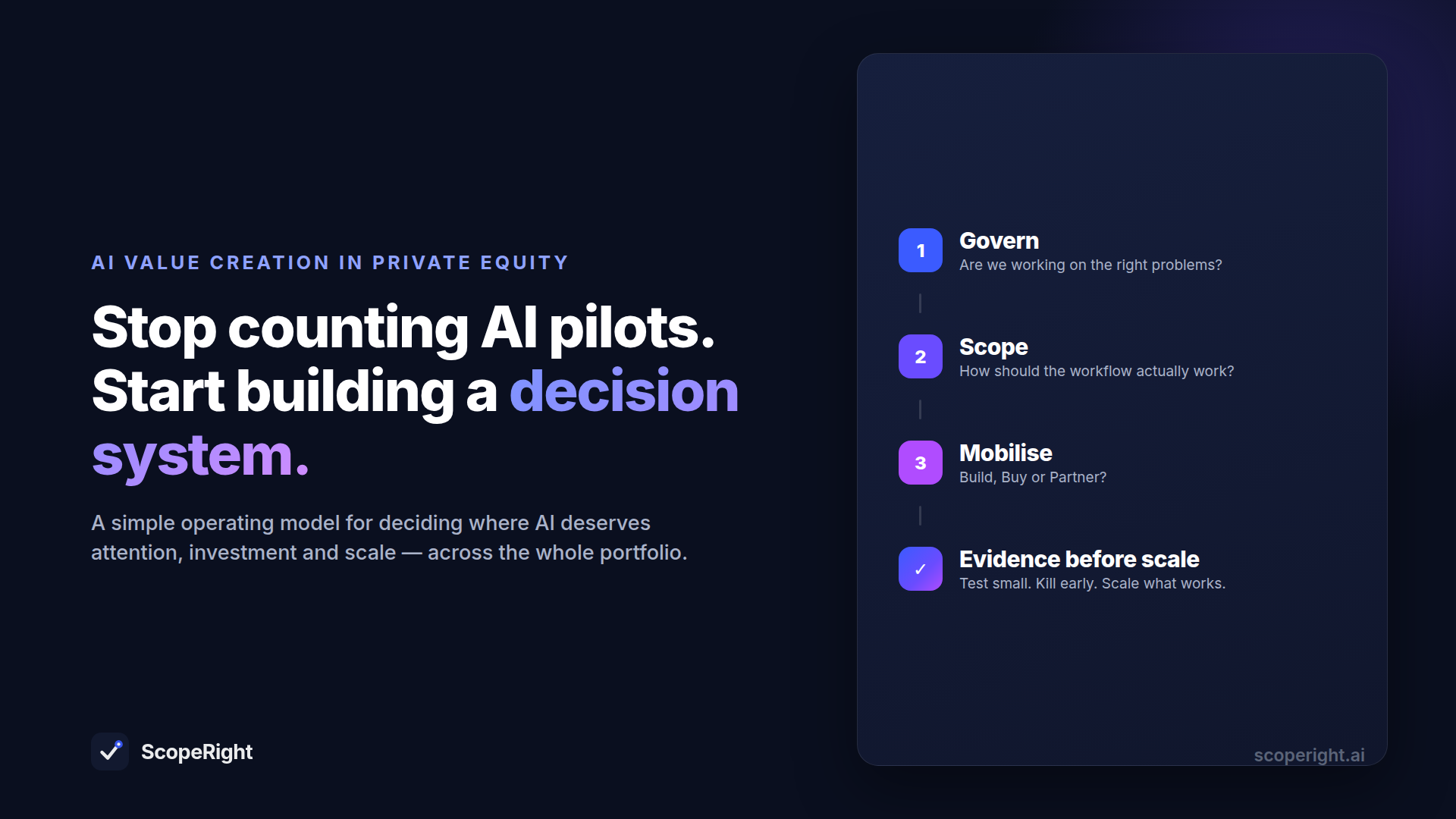
At portfolio level, operating partners need to be able to answer three questions consistently.
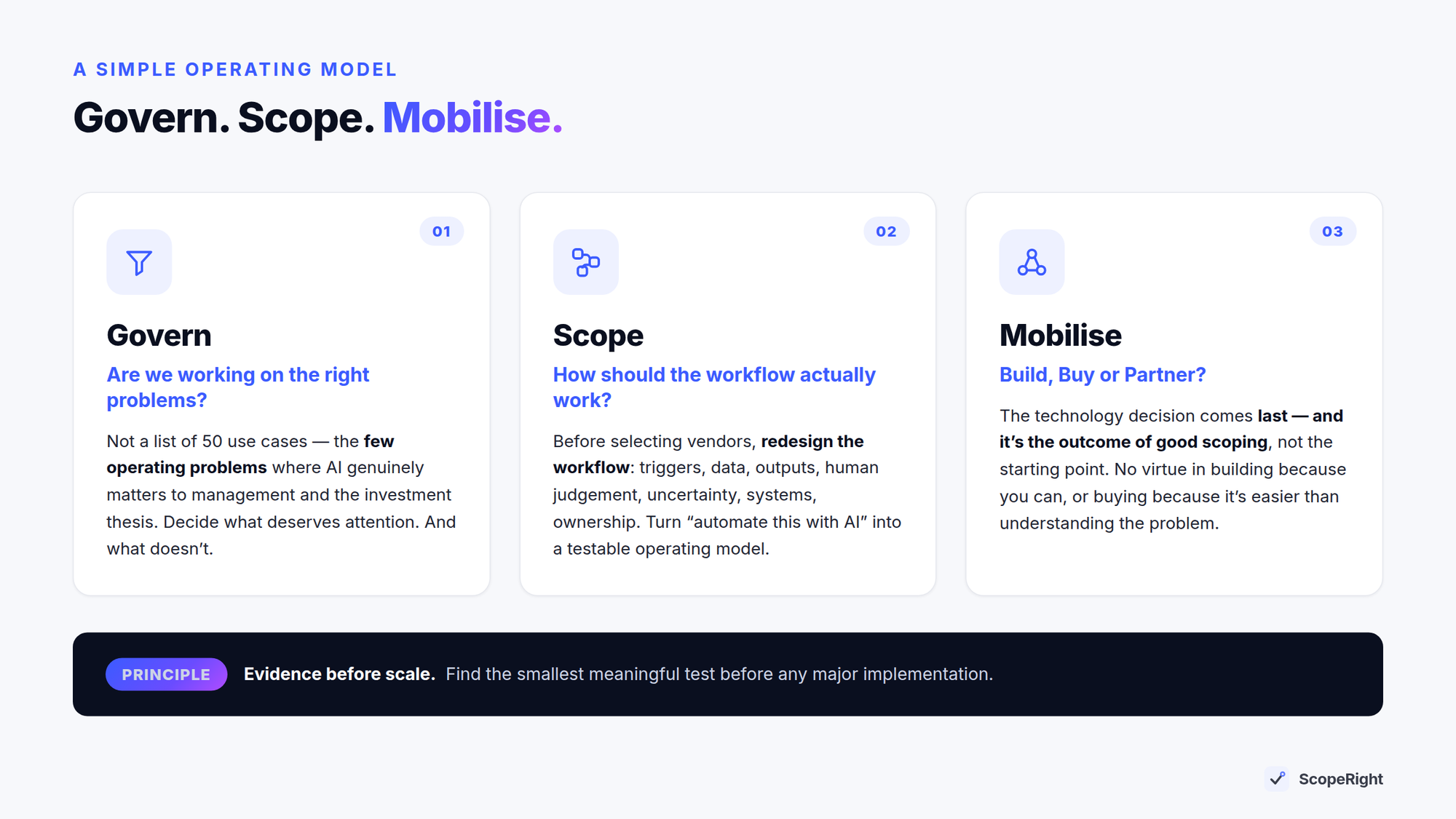
1. Govern: Are we working on the right problems?
Every company can generate dozens of plausible AI ideas.
That is not the difficult part.
Prioritisation is.
A useful AI use case should start with a real operating problem or opportunity rather than with an available AI feature.
The purpose of governance is therefore not to create another innovation committee.
It is to create a disciplined mechanism for deciding:
- which problems deserve attention;
- which opportunities are strategically relevant;
- which experiments should receive resources;
- and which ideas should be killed early.
2. Scope: How should the workflow actually work?
Once a use case looks attractive, the next question is not immediately which vendor to select.
It is how the operating model should change.
What triggers the workflow?
What information does the AI need?
What should it produce?
Where does human judgement remain essential?
What happens when confidence is low?
How does output move into the next system or process?
Who owns the result?
This is AI scoping.
AI scoping translates an interesting idea into a specific operating design that can actually be tested.
3. Mobilise: What is the right Build, Buy or Partner path?
Only after the workflow is sufficiently understood does the technology decision become meaningful.
The question then becomes whether the required capability should be:
Built — because the workflow or capability is sufficiently differentiated to justify proprietary development.
Bought — because the problem is standard enough that existing software solves it effectively.
Partnered — because specialist capability, implementation speed or external expertise is more valuable than building everything internally.
This is the Build / Buy / Partner decision.
It should be the consequence of good scoping, not a substitute for it.
Evidence before scale: the Minimal Viable Agent approach
One of the biggest mistakes in AI is jumping directly from an attractive idea to a large implementation.
The alternative is what we call evidence before scale.
The principle is simple:
Before investing heavily in an AI capability, generate evidence that the redesigned workflow works in practice.
This is where the Minimal Viable Agent, or MVA, comes in.
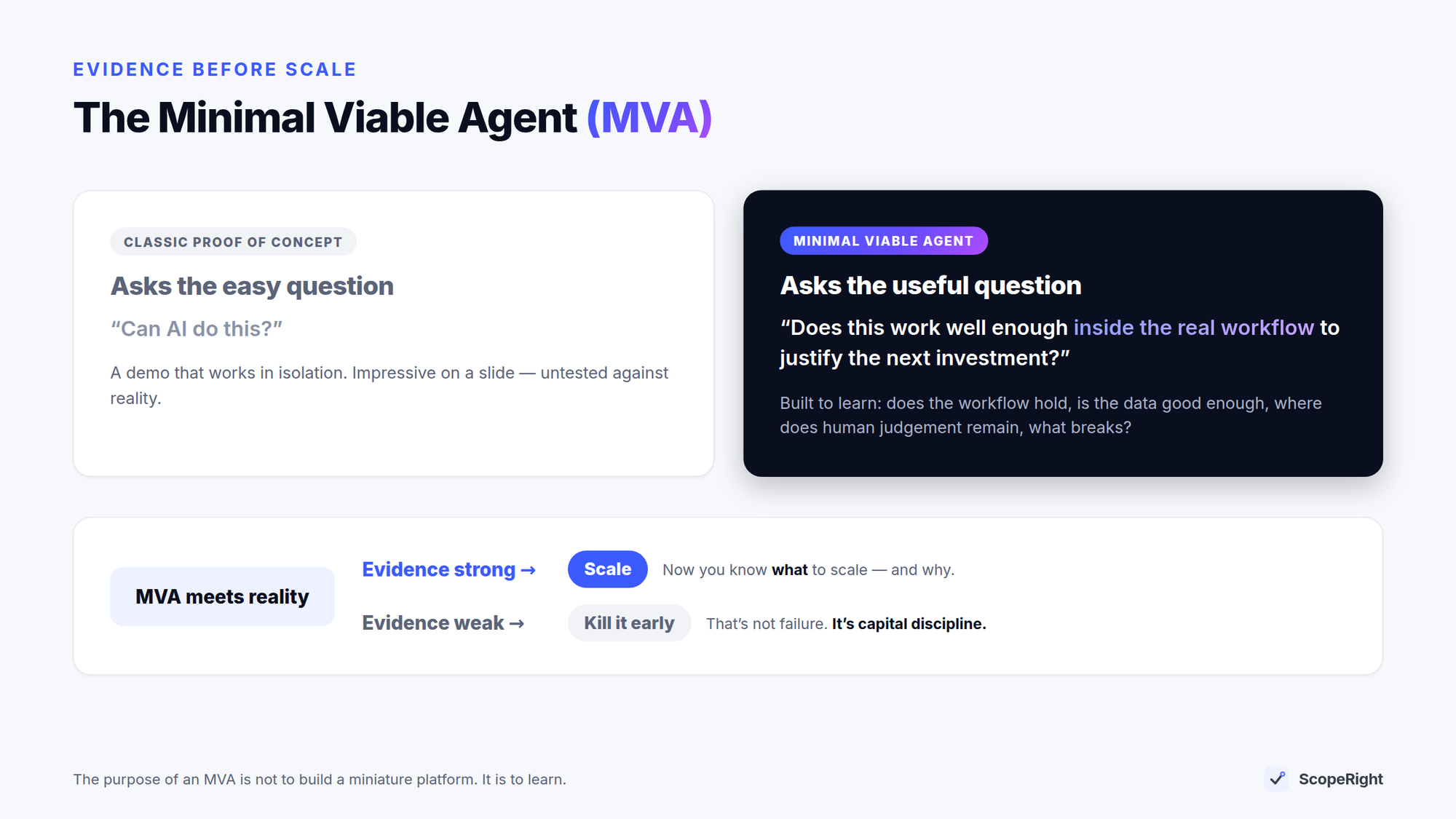
A traditional AI proof of concept often asks:
Can the technology do this?
A Minimal Viable Agent asks a more useful operating question:
Can a narrowly scoped AI agent perform a meaningful part of this real workflow well enough to justify the next investment decision?
That is an important distinction.
A demo proves possibility.
An MVA is designed to generate operational evidence.
It should be narrow enough to build and evaluate quickly, but real enough to expose the assumptions that matter.
The purpose is not to create a miniature version of the final platform.
The purpose is to learn.
Does the workflow make sense?
Does the available data support it?
Where does human judgement remain necessary?
What fails?
What unexpectedly works?
Does the capability deserve further investment?
The output of an MVA is therefore not merely software.
It is evidence for an investment decision.
That makes the approach particularly relevant in private equity, where the cost of scaling the wrong solution across multiple businesses can be much larger than the cost of killing an idea early.
Build / Buy / Partner: don't make the decision too early
Build versus buy is usually framed as a technology architecture question.
For AI, PE operators should broaden it to Build / Buy / Partner and move the decision later in the process.
First understand the workflow.
Then understand what capability it requires.
Then decide how that capability should be sourced.
A portfolio company may discover that an apparently differentiated AI opportunity can be solved perfectly well with existing software.
That should be bought.
Another workflow may depend heavily on proprietary company data, operating logic or differentiated processes.
Building may make more sense.
In other situations, the opportunity matters but developing and maintaining the entire capability internally would create unnecessary complexity.
Partnering may be the better route.
There is no virtue in building AI for the sake of owning AI.
And there is no virtue in buying software simply because procurement is easier than redesigning a workflow.
The objective is to select the model that best supports the operating requirement.
Where AI value creation shows up across the deal lifecycle
AI does not need to begin after the acquisition closes.
The same scoping discipline can be used throughout the ownership lifecycle.
Diligence and pre-close AI scoping
AI in private equity due diligence is often associated with using AI tools to analyse documents or accelerate research.
That is one application.
There is another: using diligence to identify where AI could change the future operating model of the target company.
The objective is not to produce an impressive catalogue of possible AI use cases.
It is to identify a small number of operating hypotheses worth investigating.
For each one:
What workflow could materially change?
Why does it matter?
What would have to be true?
What data and systems are involved?
Is this likely to be Build, Buy or Partner?
What should be tested after close?
This turns AI diligence from a technology checklist into an early value-creation exercise.
The first 100 days: run a use-case sprint
Post-close, the temptation is often to move immediately toward implementation.
A better first move can be a focused AI use-case sprint.
Take the strongest hypotheses from diligence and validate them inside the operating company.
Talk to the people actually performing the work.
Map the workflow.
Identify friction and exceptions.
Understand the data.
Challenge the original assumptions.
Prioritise one or two problems.
Then decide whether one deserves an MVA.
The objective of the sprint is not to create a 40-page AI roadmap.
It is to reduce uncertainty.
At the end, leadership should know substantially more clearly:
what to pursue, what not to pursue and what needs to be proven next.
Scaling what's proven, killing what isn't
Evidence before scale only works if organisations are prepared to kill ideas.
Not every MVA should become a production deployment.
That is a feature of the process, not a failure.
An experiment may reveal that the data is too poor.
The workflow may contain more tacit human judgement than expected.
The economics may be unattractive.
An existing product may turn out to solve the problem better.
The opportunity may simply be less important than another use case.
Stopping at that point protects capital and management attention.
When an MVA does produce convincing evidence, the company has something much more valuable than enthusiasm.
It has a better basis for deciding how to productionise the capability and how much to invest.
The role of an AI operating partner — and where independent scoping fits
So what does an AI operating partner in private equity actually do?
Not merely introduce AI vendors.
Not simply manage an AI software portfolio.
And not become the technical implementation team for every portfolio company.
The role is to help turn AI from scattered experimentation into a repeatable value-creation discipline.
That means helping portfolio companies:
- identify valuable operating problems;
- prioritise AI use cases;
- scope workflows before technology selection;
- challenge assumptions;
- run targeted experiments;
- decide between Build, Buy and Partner;
- and create evidence before scaling investment.
Independence matters at the scoping stage.
A software vendor naturally sees the problem through the capabilities of its product.
A systems integrator naturally sees an implementation opportunity.
A development company naturally sees something that can be built.
Those perspectives are not inherently wrong.
But they come with an answer attached.
Independent AI scoping starts one step earlier:
What is the right problem, what should the operating model become, and only then what solution deserves to win?
That is the role ScopeRight is designed to play.
Common failure modes in PE-led AI value creation programs
The same mistakes recur when AI is approached primarily as a technology program.
Starting with the vendor
"Which platform should we standardise on?" is usually a later-stage question disguised as a strategy question.
Start with the operating problem.
Creating a long AI use-case catalogue
A list of 50 possible AI applications creates activity, not prioritisation.
The objective is to identify the few problems worth solving first.
Running proofs of concept that never touch the real workflow
A technically impressive prototype can prove that AI is capable of generating an output.
It does not prove that the organisation can use that output effectively.
Testing should progressively move toward the real operating context.
Scaling before understanding the exceptions
The happy path is usually easy to automate.
The exceptions determine whether the workflow actually works.
Treating adoption as the objective
Employees using an AI tool is not the same as value creation.
Usage matters only insofar as it changes an economically or strategically relevant workflow.
Applying one solution indiscriminately across the portfolio
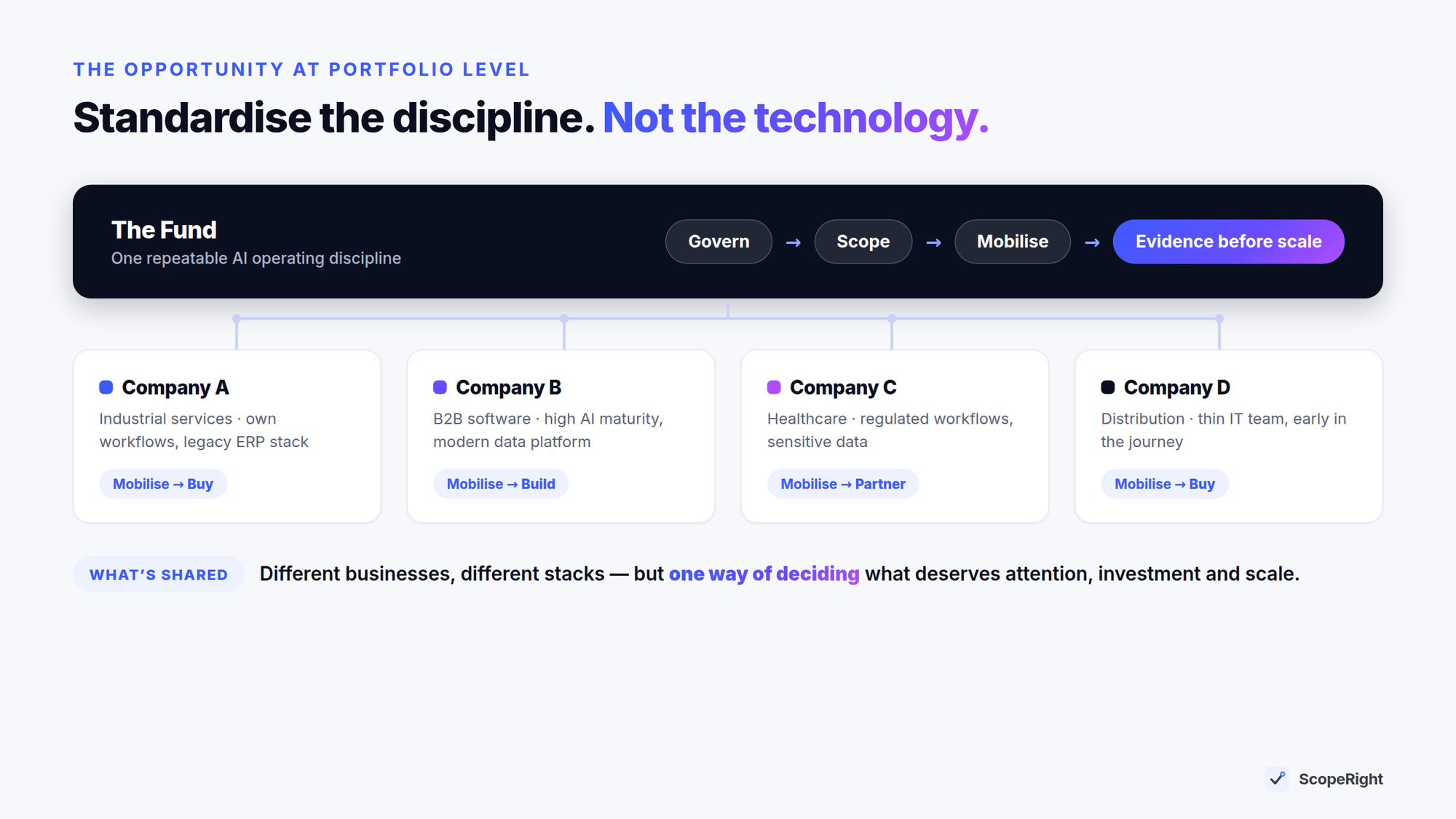
A PE fund benefits from shared methodology, governance and learning.
That does not mean every portfolio company should use the same AI architecture.
Different companies have different workflows, maturity levels, systems and economics.
Standardise the discipline. Not necessarily the technology.
A practical framework for prioritising AI use cases across a portfolio
PE operating teams need enough consistency to compare opportunities without pretending every portfolio company is identical. (For the fund-level version of this discipline, see how to prioritise AI use cases across portfolio companies.)
A practical sequence is:
Step 1 — Start with operating priorities
Do not begin with "AI opportunities."
Begin with the company's most important operating objectives, bottlenecks and sources of value.
Step 2 — Identify workflows behind those priorities
Translate strategic ambitions into actual work.
Where are decisions made?
Where does information move slowly?
Where is expert knowledge scarce?
Where does repetitive work constrain capacity?
Where could a fundamentally different workflow create an advantage?
Step 3 — Scope before selecting technology
Define what would actually have to change.
Clarify inputs, outputs, decisions, users, systems, exceptions and human oversight.
Step 4 — Prioritise the smallest valuable test
Do not try to solve the entire process immediately.
Find the narrowest intervention capable of generating useful evidence.
Step 5 — Build the MVA
Use a Minimal Viable Agent to test the critical assumptions in a real operating context.
Step 6 — Review the evidence
Did it work?
Where did it fail?
What changed operationally?
What remains uncertain?
Is this still the best use of resources?
Step 7 — Decide Build, Buy or Partner
Once the workflow and requirements are clearer, determine the right sourcing and architecture path.
Step 8 — Scale selectively
Scale what survives the evidence.
Kill or redesign what does not.
This creates a portfolio capability that compounds.
Not because every company uses the same AI tools.
Because every company gets better at making AI investment decisions.
The real PE advantage is not access to AI
Almost every company now has access to powerful AI models and increasingly capable software.
Access itself is becoming less differentiating.
The advantage lies in being able to repeatedly determine:
where AI matters, what to test, how to test it and when to scale.
That is why AI value creation in private equity should not be organised primarily around software procurement.
It should be organised as an operating capability.
Govern the right problems.
Scope the workflow.
Mobilise the right Build, Buy or Partner model.
Generate evidence before scale.
Then invest.
The winners will not necessarily be the portfolios that deploy the most AI.
They will be the ones that become systematically better at deciding where AI deserves to exist at all.
Evidence before scale
The central principle is deliberately simple:
Do not scale an AI ambition. Scale evidence that the operating model works.
ScopeRight helps private equity operating teams and portfolio-company leadership identify the right workflows, scope AI use cases and test them through Minimal Viable Agents before larger technology commitments are made.
Frequently asked questions
- What does an AI operating partner do in private equity?
- An AI operating partner helps portfolio companies identify and prioritise valuable AI opportunities, scope the underlying workflows, generate evidence through targeted implementations and determine whether a capability should be built, bought or delivered with a partner. The role is primarily an operating and capital-allocation discipline — not simply AI vendor selection.
- How do PE firms create value with AI in portfolio companies?
- PE firms create value with AI by starting from economically or strategically relevant workflows rather than from available technology. A strong process identifies the problem, redesigns the workflow, scopes the AI intervention, tests the most important assumptions and scales only after sufficient evidence exists.
- What's the difference between an AI proof of concept and a Minimal Viable Agent?
- An AI proof of concept primarily demonstrates that a technology can perform a task. A Minimal Viable Agent is a narrowly scoped AI agent designed to generate evidence about whether an AI-enabled workflow works well enough in practice to justify further investment. A POC asks: can this work? An MVA asks: does this work well enough here to deserve the next investment?
- How should a portfolio company prioritize which AI use cases to pursue first?
- Start with important operating problems rather than brainstorming AI applications. Identify the workflows behind those problems, scope what would need to change and prioritise opportunities where a relatively narrow test can resolve important uncertainty. The objective is not to create the longest AI roadmap — it is to identify the best next investment decision.
- When should a PE firm build, buy or partner for an AI capability?
- The decision should follow workflow scoping. Buy when existing software adequately meets the operating requirement. Build when proprietary workflows, data or differentiation justify custom capability. Partner when the capability matters but external expertise, speed or specialist execution offers a better path than building the full capability internally.
- What is a Minimal Viable Agent in private equity?
- A Minimal Viable Agent is the smallest meaningful AI agent implementation capable of testing whether a specific AI-enabled workflow creates enough operational evidence to justify further investment. For PE investors and portfolio companies, its purpose is to reduce uncertainty before committing capital to a larger implementation.
- How is AI value creation measured across a PE portfolio?
- There should not be one generic AI metric across every portfolio company. Measurement should follow the operating problem being addressed. The portfolio-level discipline is less about comparing raw AI adoption and more about consistently tracking which use cases were prioritised, which assumptions were tested, what evidence was produced and which initiatives subsequently earned further investment.
Evidence before scale — starting with your portfolio's first Minimal Viable Agent.
Book an AI Scoping Sprint with ScopeRight's AI Operating Partner team to identify and prioritise your portfolio's first Minimal Viable Agent. Start with a free 30-minute intake.