Search for private equity AI tools and you will find plenty of software.
Tools for diligence. Tools for market research. Tools for reporting. Copilots. Agent platforms. Data platforms. Workflow automation. Portfolio monitoring.
That is increasingly not the problem.
The harder question for an operating partner is what happens after everyone in the portfolio has access to AI.
Which workflows are actually worth changing? Which opportunities deserve investment? Which pilots should be stopped? What should be built, bought or delivered through a partner? And how do you turn what works at one portfolio company into an advantage across ten or twenty others?
A private equity firm should create portfolio-wide value from AI by running a repeatable process that identifies high-value workflows, proves them with limited investment, measures the evidence, and only then decides whether to build, buy, partner or scale.
That is an operating model, not a technology procurement exercise.
And it is becoming one of the more important capabilities inside PE value creation.
FTI Consulting's 2026 Private Equity AI Radar, based on 200 fund and operating leaders, illustrates the gap. Ninety-five percent of respondents said AI initiatives had met or exceeded their original business-case criteria. Yet only 36% reported AI being used across use cases in portfolio companies, and just 7% described AI as deployed at enterprise scale.
There is plenty of activity.
There is evidence of value.
What is still missing in many firms is the mechanism that connects the two.
Why more private equity AI tools are not the same as AI value creation
The first wave of enterprise generative AI was understandably tool-led.
Companies bought licences. Teams experimented with ChatGPT and copilots. Functions launched proofs of concept. Vendors arrived with increasingly impressive demos.
That was useful. It lowered the barrier to experimentation.
But experimentation and value creation are different disciplines.
A portfolio company can have dozens of people using AI and still have no material AI value creation plan. It can run five pilots without knowing which one deserves another euro of investment. It can select an enterprise platform before deciding which workflow it actually wants to improve.
At portfolio level, those problems compound.
One company tests one tool. Another buys a competing platform. A third hires a consultancy to automate a similar workflow. A fourth does nothing because management does not know where to start.
Twelve months later the fund has accumulated AI activity, but very little reusable knowledge.
That is the difference between portfolio-level AI activity and portfolio-level AI capability.
The real objective is not more AI. It is repeatability.
The opportunity for PE is not simply to make each portfolio company slightly better at adopting AI.
It is to learn faster than each portfolio company could learn independently.
That is what makes the portfolio structure valuable.
A successful pricing intervention, procurement methodology or sales effectiveness playbook becomes more powerful when the learning can be reused. AI should work the same way.
Large PE platforms are already building capabilities around that principle. Blackstone describes an operating model in which its central team uses AI across the investment process while helping portfolio companies accelerate growth. Apollo similarly has dedicated Data, Digital & AI operating leadership working across thesis development, sourcing, diligence and portfolio value creation.
Mid-market funds do not need to recreate Blackstone's or Apollo's infrastructure.
They do need the underlying discipline.
What an AI value creation plan in private equity actually needs to contain
An AI value creation plan is not a list of software products or an inventory of ideas.
It is a structured process for moving from opportunity to evidence to investment.
At minimum, it should answer five questions:
- Where could AI materially change a workflow or business outcome?
- Which opportunities deserve to be tested first?
- What is the smallest implementation that can produce credible evidence?
- What evidence determines whether the initiative stops, changes or scales?
- If it works, should the capability be built, bought or delivered through a partner?
This creates a fundamentally different sequence from the traditional technology approach.
Instead of:
Find tool → buy licence → look for adoption → hope for ROI
the sequence becomes:
Find workflow → scope opportunity → test value → collect evidence → decide Build/Buy/Partner → scale selectively
We call the principle behind that sequence evidence before scale.
Evidence before scale means delaying major technology, implementation and rollout commitments until a bounded AI use case has produced enough real-world evidence to justify them.
It is simple, but it changes the economics of experimentation.
Use-case prioritization: start with workflows, not AI ideas
Almost every company can now produce a long list of AI use cases.
That is not particularly valuable.
The scarce capability is deciding which ones deserve management attention.
A useful AI use-case prioritization process starts one level below the generic idea.
"Use AI in customer service" is not yet a use case.
"Analyse incoming support requests, retrieve the correct policy information and prepare a proposed response for a service agent" is much closer.
The more precisely the workflow is defined, the more precisely the business case can be tested.
This is why workflow scoping matters.
An operating partner should be able to challenge a portfolio company on questions such as:
- What decision or task are we changing?
- Who performs it today?
- What inputs are required?
- Where does time, capacity or quality get lost?
- Which systems and data does the workflow depend on?
- What needs human approval?
- What would need to improve for management to consider the intervention worthwhile?
- Could the same workflow pattern exist elsewhere in the portfolio?
The last question is particularly important.
A good portfolio AI opportunity is not necessarily the largest use case inside one company. It can also be an opportunity where the learning is highly reusable.
Finance, sales operations, customer support, procurement, reporting, compliance and knowledge-intensive back-office processes often contain recurring workflow patterns across otherwise very different companies.
The fund should be looking for both company-level impact and portfolio-level repeatability.
Evidence before scale: why pilots should initially stay small
AI pilots have acquired a bad reputation because many never go anywhere.
The problem is not that pilots are too small.
It is often that they are badly designed.
A proof of concept can prove that technology works without proving that the investment makes sense.
That distinction matters.
A model producing an impressive answer in a sandbox tells you very little about whether a real workflow can run reliably with real company data, actual users, existing systems, security constraints and human approvals.
The objective of an early AI initiative should therefore not be to demonstrate AI.
It should be to reduce uncertainty.
Can the workflow be improved?
Can the required data be accessed?
Can the output reach an acceptable quality level?
Will employees actually use it?
Where does human intervention remain necessary?
What does it cost to operate?
What needs to change before it could scale?
The pilot has done its job when management can make a better investment decision because of it — including the decision not to proceed.
Killing a weak AI use case after a small experiment is not failure.
Scaling it before discovering the weakness is.
The AI due diligence question every deal team should be asking
AI value creation should not start six months after acquisition.
Some of the highest-leverage questions belong in diligence.
Traditional technology diligence asks whether the systems work, whether the architecture is sustainable, whether cyber risks are controlled and whether investment is required.
AI private equity due diligence adds another layer: how will AI change the value creation potential and competitive position of this company during the ownership period?
That means looking at AI through both an upside and downside lens.
Assessing AI readiness and risk in target companies
An AI due diligence process should investigate questions such as:
Value creation potential
Where are the highest-value knowledge or process-intensive workflows? Where could AI increase capacity, improve speed or change commercial performance?
Data and system readiness
Does the company have access to the data and systems required to execute those workflows?
Execution readiness
Does management have the ownership, technical capability and operating discipline to implement AI beyond individual experiments?
Competitive exposure
Could AI materially change the economics of the company's product, service or competitive position during the holding period?
Existing AI activity
What is already being tested? What has been bought? What is producing evidence? What is simply generating noise?
Governance and risk
Which decisions can be automated, which require human oversight, and what regulatory, security or control requirements constrain deployment?
The output should not be a generic "AI maturity score."
It should feed directly into the investment thesis and value creation plan.
The diligence question becomes:
Where could AI create or destroy enterprise value during our ownership period, and what should we test first after close?
That gives the 100-day plan somewhere meaningful to start.
Build, Buy or Partner: make the technology decision after the use case is understood
One of the most expensive AI mistakes is making architecture decisions too early.
A portfolio company decides it needs an "AI platform."
Procurement launches a vendor process.
Management compares features.
Only afterwards does someone ask which workflows the platform is expected to transform.
Reverse the sequence.
First prove that a sufficiently valuable problem exists.
Then determine the right implementation model.
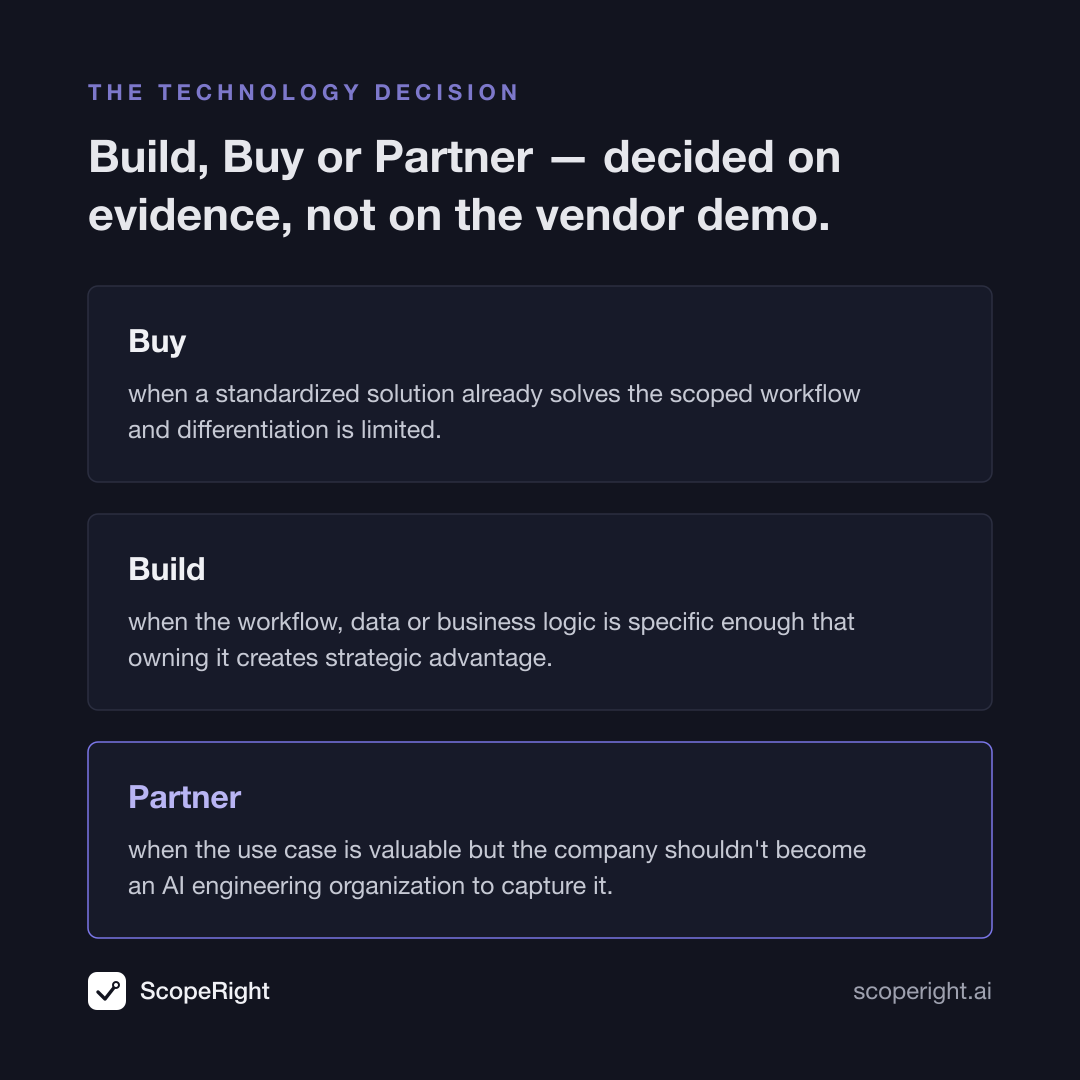
The Build/Buy/Partner framework provides three broad paths.
Buy
Buy when a sufficiently standardized solution already solves the use case and proprietary differentiation is limited.
The question is not whether a vendor has impressive AI.
The question is whether its product solves the scoped workflow with acceptable economics, integration requirements, governance and user adoption. (Before signing, an independent proposal review is a cheap way to pressure-test scope, budget logic and hidden risks.)
Build
Build when the workflow, data, integration or underlying business logic is sufficiently specific that owning the capability creates meaningful strategic advantage.
"Build" does not necessarily mean developing an AI model from scratch.
Increasingly it means assembling existing models, infrastructure and components into proprietary workflows and agents around the company's own context and intellectual property.
Partner
Partner when the use case is valuable but neither a standard product nor an internal build is the best route.
A specialist implementation or technology partner can configure, integrate or operate the capability without forcing the portfolio company to build an entirely new team.
For many mid-market portfolio companies, this will be an important route.
They need access to AI capability without turning every company into an AI engineering organization.
The strategic question is therefore not Build versus Buy.
It is Build, Buy or Partner — based on evidence from the use case.
Minimal Viable Agents: prove the workflow, not the slide deck
Traditional software development gave us the Minimum Viable Product.
Agentic AI needs a related but different concept.
We call it the Minimal Viable Agent, or MVA.
A Minimal Viable Agent is the smallest working agentic implementation capable of testing whether AI can create measurable value inside one clearly bounded business workflow.
An MVA is not supposed to be the finished enterprise solution.
Its job is to answer the questions management needs answered before committing more capital.
That could mean connecting an agent to a limited set of documents rather than an entire enterprise data estate.
Working with a small user group instead of an entire department.
Keeping a human approval step where future automation may eventually be possible.
Using existing tools and APIs rather than engineering the final architecture.
The goal is not elegance.
The goal is evidence.
That makes the Minimal Viable Agent particularly relevant in private equity.
PE operates under time constraints. Management bandwidth is scarce. Holding periods are finite. Every technology investment competes with other value creation priorities.
The MVA forces the organization to answer the important question early:
Is there enough value here to justify going further?
What an MVA can look like inside a 100-day plan
By day 100, a portfolio company should ideally know more than which AI platform it intends to buy.
It should already have evidence from at least one meaningful workflow.
An illustrative sequence could look like this:
Early in the 100-day plan: map and prioritize AI opportunities against the investment thesis and operational priorities.
Next: select one or a small number of high-value workflows and scope them precisely.
Then: deploy a Minimal Viable Agent against the strongest candidate, with real users and sufficiently representative data.
Before the 100-day checkpoint: review the evidence and decide whether to stop, iterate, buy, build, partner or prepare for broader deployment. (This is also where delivery oversight through the first critical months keeps business value, architecture and adoption aligned.)
This does not mean every production implementation should be complete in 100 days.
It means the first major capital decision should increasingly be based on evidence rather than assumption.
That is a much stronger starting point for the remainder of the holding period.
What private equity AI tools actually support — and what they cannot replace
There is no universal list of the "best private equity AI tools."
There are useful categories of technology.
But the technology stack should support the operating model, not define it.
| Tool category | What it can support | What it does not replace |
|---|---|---|
| General-purpose LLMs and copilots | Research, drafting, knowledge work and individual productivity | Workflow scoping and value-case selection |
| Agent and automation platforms | Orchestrating tasks, models, integrations and approvals | Deciding which processes deserve automation |
| Data and integration infrastructure | Making enterprise context accessible to AI systems | A clear business case |
| Vertical AI applications | Solving standardized functional or industry workflows | Validation that the solution fits the specific portfolio company |
| Evaluation and governance tooling | Monitoring quality, controls, security and AI behaviour | Operating ownership |
| Portfolio and analytics platforms | Aggregating company and performance information | Discovering operational opportunities without management context |
Software is an accelerator.
It is not the strategy.
The best private equity AI tool for one use case may be entirely inappropriate for the next.
That is why tool selection should come downstream of AI scoping.
How do PE firms measure ROI on AI?
This is where the original workflow definition becomes important.
You cannot measure AI ROI credibly if you never established what the agent was supposed to change.
Start at workflow level.
If the objective was to accelerate a process, measure cycle time.
If it was to improve quality, measure relevant error or rework rates.
If it was to release employee capacity, measure the capacity freed and what happens to it.
If the intervention is commercial, connect measurement to the commercial outcome the use case was designed to influence.
The KPI should follow the business problem.
Not the technology.
Portfolio-level measurement requires another layer
The operating partner also needs a portfolio view.
Not because every use case should share the same KPI — that would make little sense — but because the value creation process can be standardized even when the business outcomes differ.
Useful portfolio-level questions include:
- How many meaningful workflows have been scoped?
- Which have moved into MVA testing?
- How quickly are initiatives reaching evidence?
- Which have been stopped, iterated or approved for scale?
- Which solutions are being built, bought or delivered through partners?
- Where can an already-proven pattern be reused elsewhere?
- Which initiatives have translated into measurable operating outcomes?
This is the beginning of a portfolio AI learning system.
The objective is not to produce an impressive dashboard of AI activity.
It is to make better capital allocation decisions and increase the speed at which successful patterns travel across the portfolio.
The AI Operating Partner is an operating capability, not an AI evangelist
This also changes the role of an AI Operating Partner.
The job is not to convince CEOs that AI matters.
Most already know.
It is not to arrive with a preferred technology stack.
And it should not be to run an endless series of innovation workshops.
The AI Operating Partner should create the mechanism that moves the portfolio from scattered experimentation to repeatable execution.
That means helping portfolio companies:
- identify and scope material opportunities;
- challenge weak or technology-led use cases;
- structure use-case sprints;
- define evidence and kill criteria;
- rapidly create or coordinate MVAs;
- make independent Build/Buy/Partner decisions;
- identify specialist technology and delivery partners where necessary;
- capture reusable knowledge across companies;
- and connect the evidence back to the value creation plan.
The capability can be internal, external or hybrid.
What matters is that someone owns the operating system.
Blackstone provides one example at large scale: a central Operating Team working across a portfolio of hundreds of companies, creating the potential for insights and practices to travel across the portfolio.
The model will look different for a mid-market fund.
The principle should not.
Do not make every portfolio company reinvent AI adoption independently.
From one AI pilot to a portfolio-wide playbook
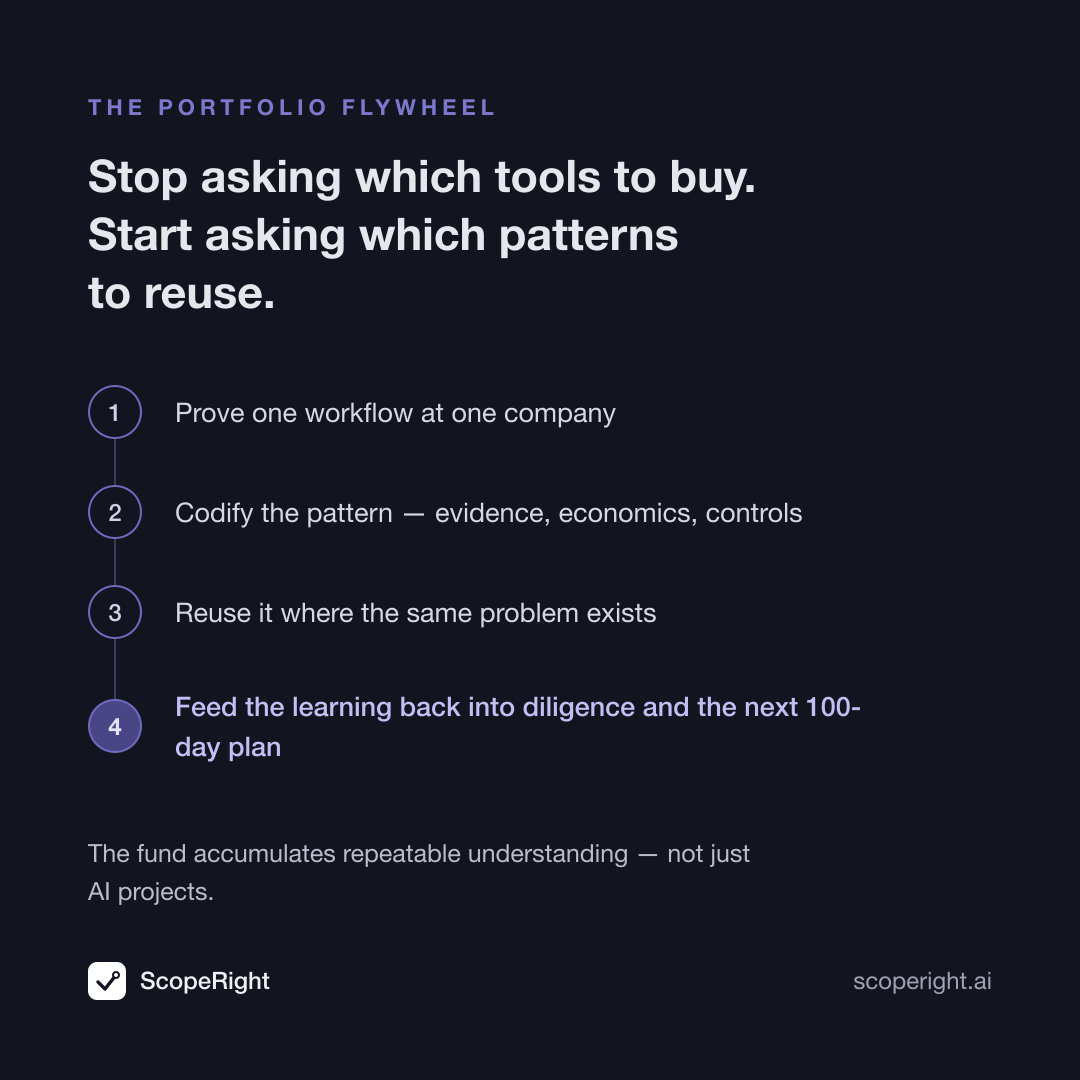
The portfolio-wide model does not require launching ten projects at ten companies at once.
In fact, the opposite is usually more sensible.
Start narrow.
Learn.
Codify.
Then expand.
Phase 1: Establish the portfolio opportunity map
Identify where AI is strategically relevant across the portfolio.
Do not create a database of hundreds of generic ideas. Look for areas tied to the investment thesis, operational bottlenecks, growth opportunities and recurring workflows. An outside-in benchmark of what peers, adjacent industries and AI-native organisations are already doing can sharpen this map quickly.
Phase 2: Run one use-case sprint
Pick a portfolio company with an engaged management team and a sufficiently meaningful opportunity.
Scope the workflow.
Define the expected outcome.
Establish what evidence will be required.
Phase 3: Build the Minimal Viable Agent
Create the smallest implementation capable of testing the core assumptions.
Keep infrastructure and organizational complexity proportionate to the uncertainty you are trying to remove.
Phase 4: Make the Build/Buy/Partner decision
Use the MVA evidence to determine the implementation route.
Only now should larger technology commitments begin.
Phase 5: Codify the pattern
Capture more than the code.
Document the workflow.
The business case.
Required data.
Human controls.
Integrations.
Governance.
Lessons learned.
Implementation partners.
Economics.
What failed.
What worked.
This is where individual experimentation starts becoming portfolio IP.
Phase 6: Find the next comparable workflow
Do not simply "roll out the tool."
Search the portfolio for companies where the same operating problem exists.
The reusable asset is often not the application itself.
It is the combination of workflow understanding, implementation pattern, evidence and judgment about where the solution works.
Phase 7: Bring the learning back into diligence and the next 100-day plan
Eventually the flywheel closes.
Patterns learned inside existing portfolio companies improve future diligence.
Diligence improves the next value creation plan.
The next value creation plan reaches useful AI evidence faster.
Each implementation teaches the portfolio something.
That is what compounding looks like.
The real PE advantage is not access to AI
Every portfolio company has access to increasingly capable models.
Every competitor can buy software.
And models themselves will continue to become cheaper, faster and more interchangeable.
The defensible advantage sits elsewhere.
It sits in understanding which proprietary workflows matter.
In knowing where AI actually changes the economics.
In capturing the judgment of strong operators.
In connecting AI to data, processes and systems.
In knowing which initiatives to kill.
In making better Build/Buy/Partner decisions.
And, above all, in transferring those lessons across the portfolio faster than competitors can.
That is why AI value creation in private equity is an operating-capability question first and a technology question second.
The funds that understand this will stop asking:
Which AI tools should our portfolio companies buy?
And start asking:
Which value creation patterns can we prove once, learn from and systematically reuse?
That is a much more valuable question.
Start with evidence, not infrastructure
ScopeRight helps private equity operating partners and portfolio company leadership teams identify and prioritize AI opportunities before major budgets are committed.
We independently scope the workflow, define the business case, create a Minimal Viable Agent where appropriate and help determine the right implementation route: Build, Buy or Partner.
Talk to an AI Operating Partner about scoping your first portfolio-wide AI value creation sprint.
Frequently asked questions
- What is an AI value creation plan in private equity?
- An AI value creation plan is a structured, portfolio-wide approach that prioritizes AI use cases by potential impact, tests them before major investments are made and ties each initiative to a measurable operating or commercial outcome rather than treating AI as a standalone IT project. The objective is to create a repeatable mechanism for finding, proving and scaling AI opportunities throughout the ownership period.
- How do PE firms avoid AI pilots that never scale across the portfolio?
- Require evidence before scale. Scope one concrete workflow, prove it through a Minimal Viable Agent, measure what changed and use the evidence to make an explicit Build/Buy/Partner decision. A pilot should not automatically lead to a rollout. It should lead to a decision.
- What KPIs prove AI is creating value in a portfolio company?
- The KPI should reflect the workflow the AI intervention was designed to improve. Examples include cycle time, error or rework rates and employee capacity freed; commercial initiatives should be connected to the commercial outcome they were intended to influence. At portfolio level, operating partners should additionally track how quickly use cases move from scoping to evidence, which initiatives scale or stop and where proven patterns can be reused across companies.
- What AI tools should a private equity firm evaluate for portfolio-wide value creation?
- Tool selection should follow use-case scoping rather than precede it. Once a workflow and business case have been validated, the firm can evaluate whether the right path is an existing application, an agent or automation platform, a custom implementation or a specialist technology partner. The relevant question is not 'What is the best private equity AI tool?' but 'What is the best implementation path for this proven use case?'
- What software do PE firms use to identify AI value creation opportunities?
- Software can support research, process analysis, data discovery and portfolio monitoring, but it cannot independently determine which operational problems deserve investment. That requires workflow-level context, management judgment and a prioritization process tied to the value creation thesis. Software can accelerate AI scoping. It does not replace it.
- How should a mid-market PE firm build an AI value creation playbook for portfolio companies?
- Start with one portfolio company and one sufficiently valuable workflow. Run a focused use-case sprint, establish success and kill criteria, create a Minimal Viable Agent and generate real evidence. Then make the Build/Buy/Partner decision and codify what was learned before applying the pattern elsewhere. You do not need a large centralized AI department to start building portfolio capability. You need a repeatable process.
Start with evidence, not infrastructure.
ScopeRight helps private equity operating partners and portfolio company leadership teams identify and prioritize AI opportunities before major budgets are committed. We independently scope the workflow, define the business case, create a Minimal Viable Agent where appropriate and help determine the right implementation route: Build, Buy or Partner.