Why AI harnesses could become the missing link between enterprise software, AI models and real business value.
Over the past few weeks, we've noticed a remarkable shift in the conversations we're having with companies at ScopeRight.
Businesses are no longer simply asking which AI tool they should use. They're asking how to make AI work across their existing systems, people and processes.
And increasingly, the answer points in the same direction: an AI-powered workflow layer on top of existing ERP and CRM systems.
It's a fundamental shift from buying AI licences to building AI-powered business applications.
The AI adoption paradox: plenty of licences, very few applications
ChatGPT, Claude and Microsoft Copilot have found their way into many organisations.
Employees use them to draft emails, summarise documents, analyse information and generate ideas.
These are useful productivity gains. But when we ask companies which core business processes are actually powered by AI, the answer is often surprisingly limited.
The challenge isn't access to AI models. It's connecting those models to the systems, knowledge and workflows that make a business run.
Giving employees access to AI is not the same as integrating AI into your organisation.
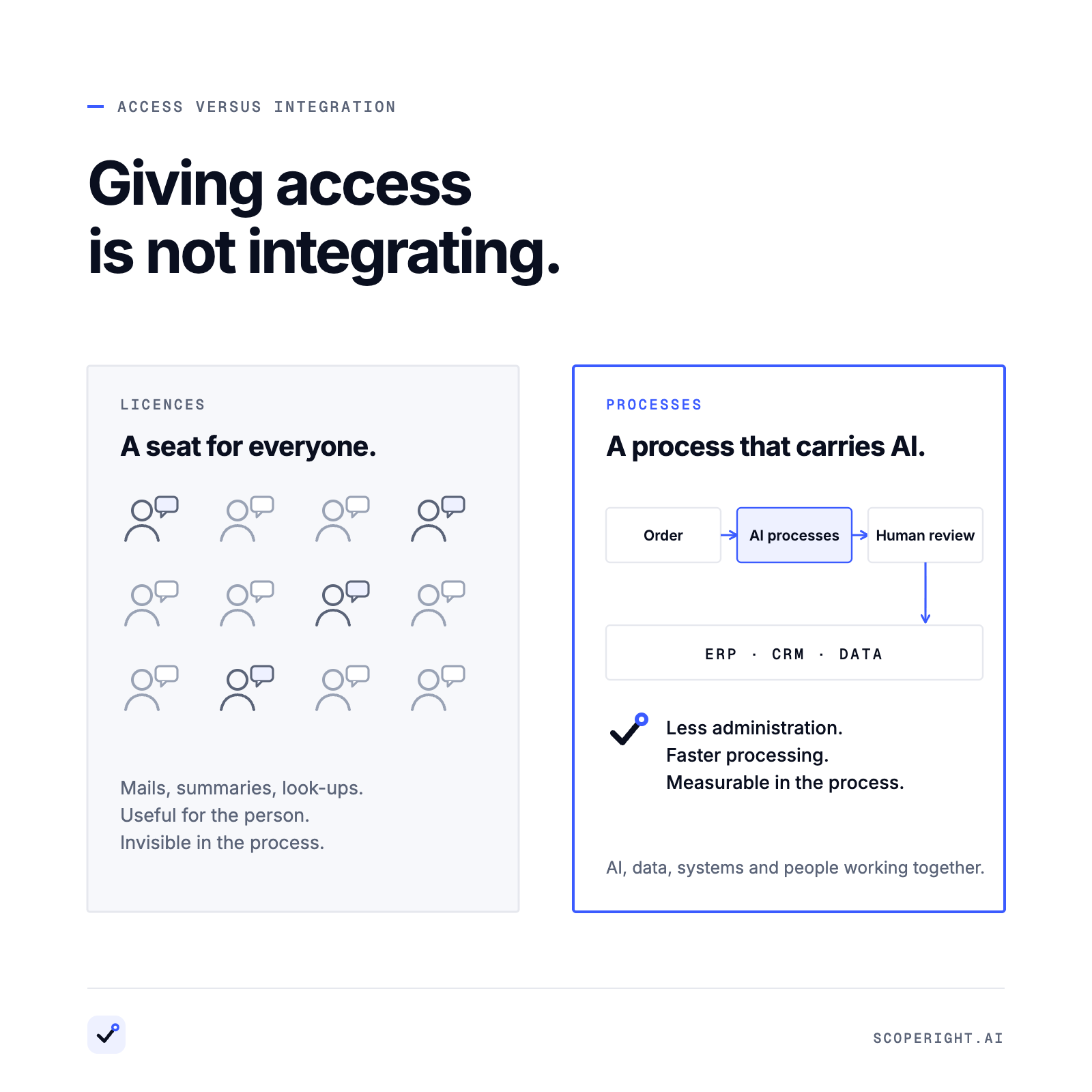
And that's precisely where traditional enterprise software architectures are showing their limitations.
Why companies need a workflow layer on top of ERP and CRM
ERP and CRM systems remain essential. They manage transactions, customer information, financial data, inventory and operational records.
But many everyday processes happen between these systems.
An order arrives by email, needs to be interpreted, entered into the ERP, checked against inventory, included in transport planning and communicated to a customer. We describe that workflow in more detail on our AI order processing page.
Each step may involve a different system, spreadsheet or person.
Traditional integrations can move data between systems. What companies increasingly need is a layer that can also interpret information, coordinate actions, apply business rules and involve people when decisions are required.
That's what an AI-powered workflow layer can deliver.
Rather than replacing ERP or CRM, it works on top of them, connecting existing systems and orchestrating the processes that run across them.
The distinction is important:
- ERP and CRM remain the systems of record, managing core business data and transactions.
- The workflow layer becomes a system of action, coordinating tasks, AI models, applications and human decisions.
- An AI harness provides the shared foundation, including integrations, memory, model routing, security and governance.
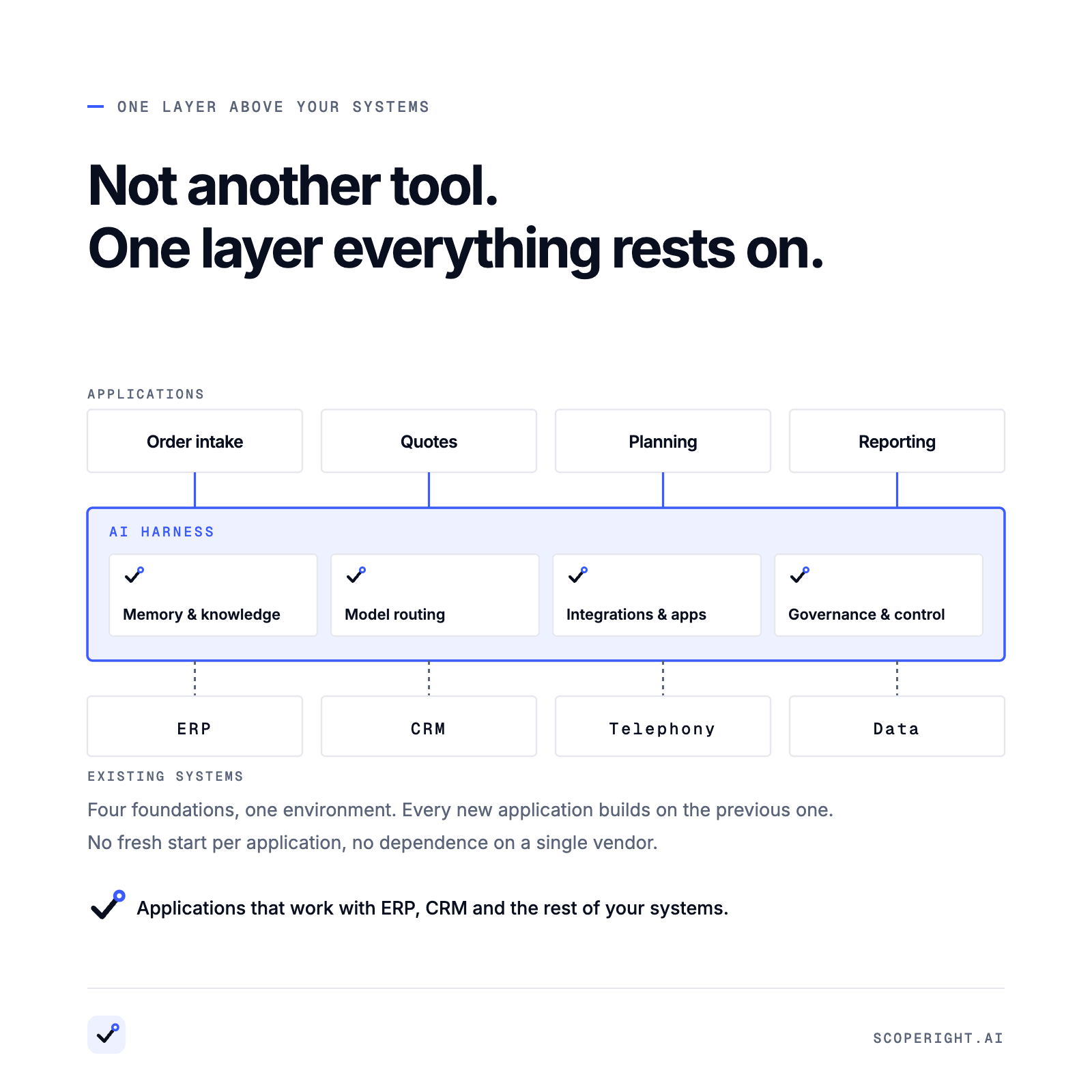
This architecture allows businesses to modernise how work gets done without immediately replacing the systems they already depend on. Where Microsoft, Salesforce or SAP already offer the right AI capability, we start there; see AI platform acceleration.
Real business cases: what we're seeing in the field
Recent projects and conversations at ScopeRight illustrate how this shift is taking shape.
Manufacturing: connecting orders, logistics and product knowledge
At a food manufacturing company, we're exploring how AI can support incoming order processing, transport planning and the preparation of complex product specifications.
Today, relevant information is distributed across email, Excel, local documents and an ERP platform.
A workflow layer could connect these sources, apply business rules and help employees execute processes more efficiently.
The importance of governance also became clear during experimentation: an AI-generated product specification introduced an incorrect allergen. A reminder that reliable AI applications need validation, controlled workflows and human oversight, and that evals define what good performance looks like before a task is delegated.
Insurance: moving from opportunities to measurable applications
At an insurance organisation, we're preparing three AI use cases for testing as working MVPs over six to eight weeks.
The objective isn't to demonstrate what AI can do in isolation, but to measure its contribution to efficiency, operational capacity and commercial value. That is the logic of a Minimal Viable Agent sprint.
These applications must fit within an existing technology landscape and its security and governance requirements.
Sales operations: connecting CRM, ERP and customer interactions
At a technology company, we're examining how a fragmented commercial process can become one integrated workflow.
Today, customer information, quotations, telephone conversations, documents and ERP transactions are spread across multiple tools.
The opportunity is to bring them together through an AI-enabled interface that supports the sales process from initial customer contact to order management and reporting, the kind of flow we outline for sales and CRM.
Different industries, different processes, but the same underlying need.
Not another chatbot. A shared foundation for applications that work across existing systems.
AI harnesses: the architecture behind the workflow layer
We believe AI harnesses will play an increasingly central role in making this possible.
An AI harness is a common technology foundation for building, running and governing AI applications.
Instead of developing each application as an isolated solution, organisations can reuse the same core capabilities:
- Centralised knowledge and memory: shared business context with controlled access across teams and applications.
- Intelligent model routing: selecting the most suitable AI model for each task based on quality, capabilities, speed and cost.
- System integrations and custom applications: connecting ERP, CRM, documents and other enterprise data sources to reusable AI-powered workflows.
- Built-in governance: permissions, human approvals, monitoring and evaluation across applications.
There's another important advantage: independence from individual AI providers.
Claude may be the best model for a particular task today, while an OpenAI model may perform better for another. Six months from now, that balance could change.
Why build your entire AI architecture around one model vendor?
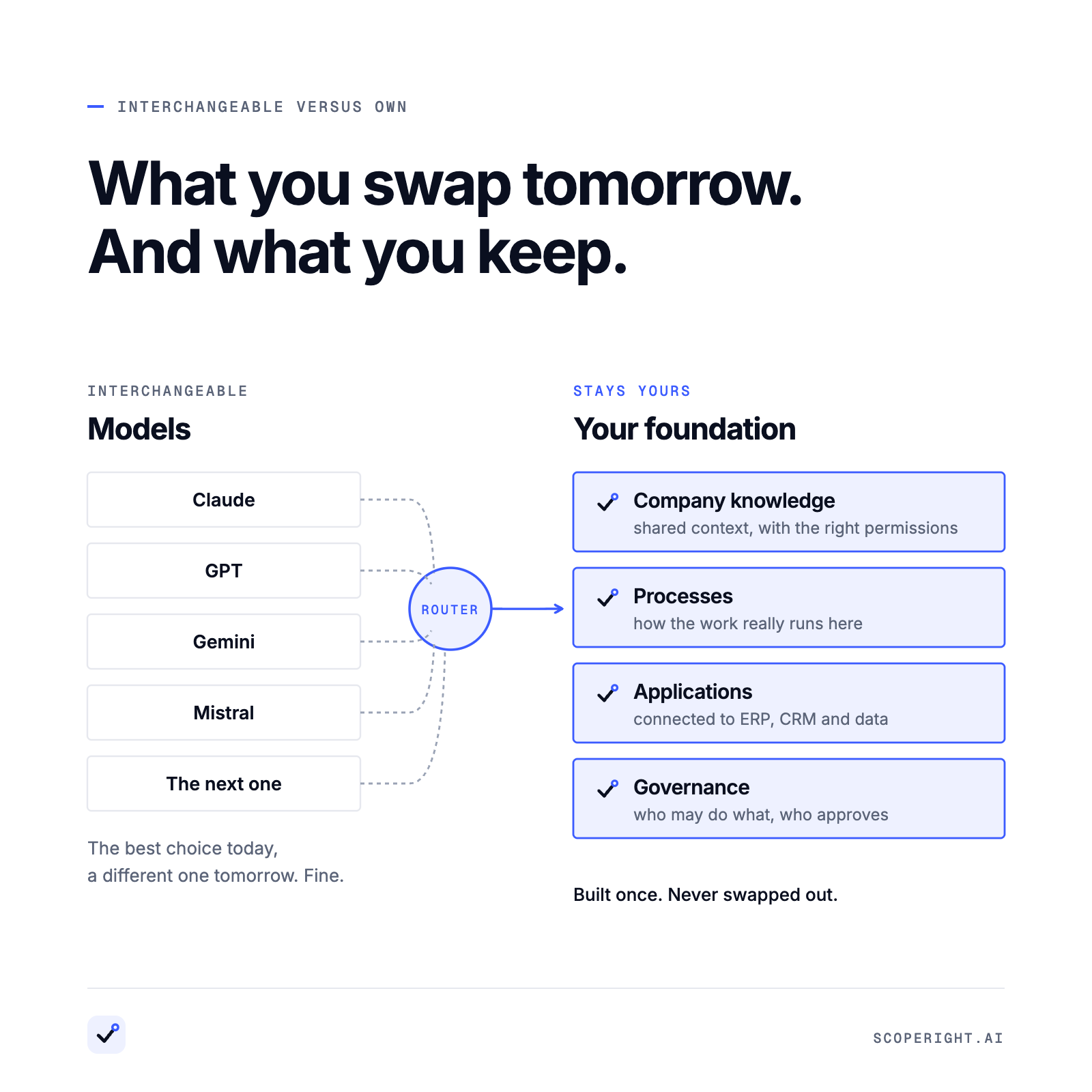
AI models will evolve. Your business knowledge, processes and applications should remain yours.
Nova, the backbone and build team co-founded by ScopeRight's founder, describes the builder's side of this in one harness, many applications: why every next application on a shared foundation costs less than the last.
From AI seats to AI systems
We're also seeing a growing tension between local AI innovation and central IT governance.
Business teams want to experiment and move quickly. IT needs to ensure security, reliability, integration and control.
Without a common architecture, organisations risk creating a fragmented landscape of AI subscriptions, prototypes and disconnected applications.
A shared workflow layer can help bridge that gap.
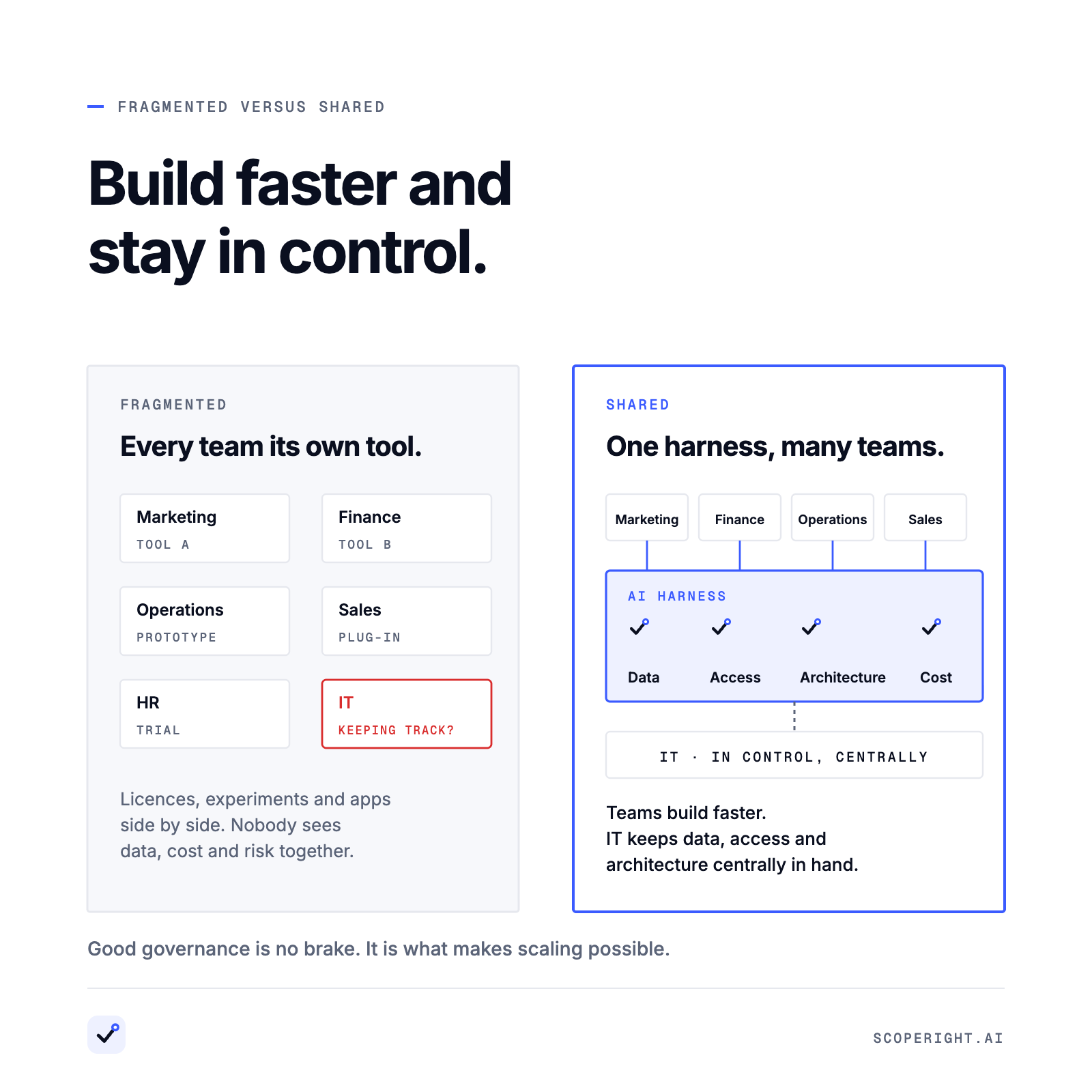
Teams gain the ability to develop applications faster, while IT maintains control over how data, models and existing systems are accessed.
Of course, not every company needs a comprehensive AI platform from day one. Sometimes an existing SaaS application is the right choice.
But as soon as multiple AI applications require the same business knowledge, integrations and governance, a shared architecture becomes increasingly compelling.
The next phase of enterprise AI
At ScopeRight, we're seeing a sharp acceleration in demand for precisely this approach.
Companies are moving beyond discussions about AI adoption and starting to focus on the applications that can transform how their businesses operate.
We welcome that evolution.
Because the next phase of AI transformation won't be defined by how many ChatGPT, Claude or Copilot licences a company has deployed.
It will be defined by how effectively companies integrate AI into their existing business processes.
The winners won't necessarily be the companies with the most AI tools. They'll be the ones that build the most valuable AI-powered workflows on top of the systems they already have.
And that's why we believe AI harnesses and enterprise workflow layers will become an increasingly important part of the enterprise technology landscape.
Our starting point isn't the technology. It's understanding how your business works, where AI can create measurable value, and what architecture will support it sustainably. That is what an AI Field Sprint is built for, and the route into AI implementation follows from it.
Client examples are anonymised and based on recent discovery sessions, experiments and ongoing engagements.
Frequently asked questions
- What is an AI workflow layer?
- An AI workflow layer sits on top of existing ERP and CRM systems and coordinates the processes that run between them. It interprets information, applies business rules, triggers actions and involves people when a decision is needed. ERP and CRM stay the systems of record; the workflow layer becomes the system of action.
- What is an AI harness?
- An AI harness is a shared technology foundation for building, running and governing AI applications. It provides centralised knowledge and memory, model routing, integrations with ERP, CRM and documents, and built-in governance such as permissions, human approvals, monitoring and evaluation, so each new application reuses the same capabilities.
- Do we need to replace our ERP or CRM to use AI?
- No. The workflow layer works on top of the systems you already have and connects them. That lets you modernise how work gets done without replacing the systems your business depends on.
- Is a shared AI platform always the right choice?
- No. Sometimes an existing SaaS application is the better answer. A shared architecture becomes compelling once several AI applications need the same business knowledge, integrations and governance.
- Why avoid building around a single AI model vendor?
- Because the best model for a task changes. Claude may lead for one task today and an OpenAI model for another, and that balance can shift within months. With model routing in a shared harness, models stay interchangeable while your business knowledge, processes and applications remain yours.
Ready to move beyond AI experimentation?
We help organisations identify, prioritise and implement valuable AI applications, and decide independently what to buy, configure or build. Explore how an AI workflow layer could work for your organisation.